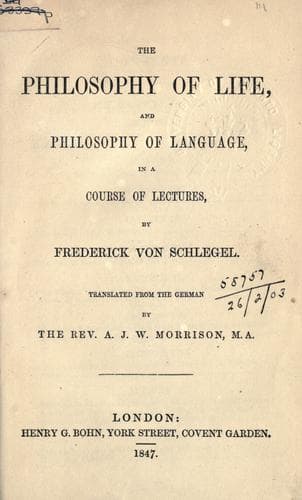
The philosophy of life, and philosophy of language, in a course of lecturesSchlegel, Friedrich von
Philosophy
The philosophy of life, and philosophy of language, in a course of lectures
Schlegel, Friedrich von
Language and languages -- Philosophy; Life; Philosophy
methodical processes, and the fancy, with its dreams of the infinite,
are again completely reconciled, and thereby the harmony of the human
consciousness restored. Fancy, I remarked formerly, is the
characteristic property of man, as distinguished by it from other
spiritual intelligences; for reason, as a mere faculty of negation,
affords only a negative distinction of his nature as compared with
irrational creatures. But now, in a more comprehensive view, and, at the
same time, with profounder significance and greater truth of
description, we may say of man, in the same sense and in the same
relation, hope forms his characteristic property and his inmost essence.
Here, then, in this holy hope, is longing, that marvelous flower of the
soul, expanded into its perfect and noblest fruit. If, in judging of the
three, man looks to the end to which he is to attain--if, in thought, he
places himself at this point of view, then assuredly will love appear
the highest and the best; for hope ceases when fulfillment comes in, and
sight enters into the place of faith, but love abideth forever.[28] As
long, however, as man has not yet attained unto that which is perfect,
and is still in pursuit of it, hope must be regarded as the greatest,
for it is even the true vital flame of faith, as well as of love, and of
all higher existence.
This divine hope is even the fruit-bearing principle and the
fructification of the immortal soul by the Holy Spirit of Eternal
Truth--the luminous center and focus of grace, where the dark and
discordant soul is illuminated and restored to unison with itself and
with God.
LECTURE VI.
OF THE WISDOM OF THE DIVINE ORDER OF THINGS IN NATURE, AND OF THE
RELATION OF NATURE TO THE OTHER LIFE AND TO THE INVISIBLE WORLD.
The highest and loftiest language would fail us were it our purpose to
speak of the inmost essence of the Godhead, since He is that which no
thought or conception can comprehend, and which no words are sufficient
completely to describe or adequately to express. On the other hand, when
we reflect on God’s work in creation, and of His superintending
providence which rules the course of this earthly world, our thoughts
can not be simple enough, nor, to judge by that principle of the divine
condescension which formed the nucleus of our remarks in the last
Lecture, too familiar or affectionate. In a general way this is commonly
enough admitted, but practically it is neglected. Men do not clearly
present to their minds all that is involved in it, and the remote
consequences to which it leads. And so, in spite of their better
convictions, they insensibly adopt a high-sounding and solemn strain,
when the tone of a childlike reverence is alone the suitable and
appropriate style for expressing the relation between the benignant
Creator and His creatures, and man especially, as simply and as
naturally as it is in reality.
Public-domain text, read in full here on John Shaqi.
Reviews
Reviews
No reviews yet
Be the first to share your thoughts on this work.
Elsewhere in the archive
Join the Discussion
Join the discussion
Sign in to leave a comment or review.
Sign InorCreate an account