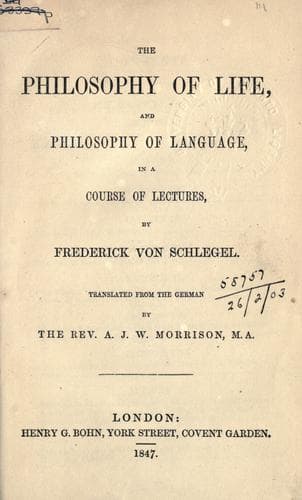
The philosophy of life, and philosophy of language, in a course of lecturesSchlegel, Friedrich von
Philosophy
The philosophy of life, and philosophy of language, in a course of lectures
Schlegel, Friedrich von
Language and languages -- Philosophy; Life; Philosophy
And is not nature, on the whole, a life-tree, as it were,
whose leaves and flowers are perpetually expanding themselves and
seeking nourishment from the balsamic air of heaven, while, as the sap
rises from the deep-hidden root into the mighty stem, the branches stir
and move, and invisible forces sweep to and fro in its waving crown.
Most shallow and superficial, in truth, is that physical science which
would consider the system of nature, with all the marvels of beauty and
majesty wherewith its Maker has adorned it, as nothing more than a piece
of lifeless clock-work. In such a system the all-mighty Creator must
appear at best but a great mechanical artist who has at his command
infinite resources; or, if we may be allowed so absurd an expression, as
the fittest to expose the absurdity of those who would regard the divine
work, both in its whole and in its parts, as dead, an omnipotent
clockmaker. If, however, to meet the needs of man’s limited capacity, we
must, when speaking of the Creator, employ such trifling and childish
similes, then of all human avocations and pursuits that of the gardener
will serve best to illustrate the divine operations in nature.
All-mighty and omniscient, however, He has Himself created the trees and
flowers that He cultivates, has Himself made the good soil in which they
grow, and brings down from heaven the balmy spring, the dews and rain,
and the sunshine that quicken and mature them into life and beauty.
If, then, there be life in nature, as, indeed, observation teaches, and
the general feeling of man avouches, it must also possess a vital
development, which in its movements observes a uniform course and
intrinsic law. In truth, the Creator has not reserved to himself the
beginning and the end alone, and left the rest to follow its own course;
but in the middle, and at every point, also, of its progress, the
Omnipotent Will can intervene at pleasure. If He pleases He can
instantaneously stop this vital development, and suddenly make the
course of nature stand still; or, in a moment, give life and movement to
what before stood motionless and inanimate. Generally speaking, it is in
the divine power to suspend the laws of nature, to interfere directly
with them, and, as it were, to intercalate among them some higher and
immediate operation of His power, as an exception to their uniform
development. For, as in the social frame of civil life, the author and
giver of the laws may occasionally set them aside, or, in their
administration, allow certain special cases of exception, even so is it,
also, with nature’s Lawgiver.
Public-domain text, read in full here on John Shaqi.
Reviews
Reviews
No reviews yet
Be the first to share your thoughts on this work.
Elsewhere in the archive
Join the Discussion
Join the discussion
Sign in to leave a comment or review.
Sign InorCreate an account