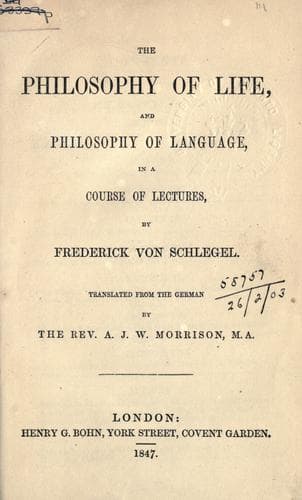
The philosophy of life, and philosophy of language, in a course of lecturesSchlegel, Friedrich von
Philosophy
The philosophy of life, and philosophy of language, in a course of lectures
Schlegel, Friedrich von
Language and languages -- Philosophy; Life; Philosophy
I said as naturally, because it is implied in the very nature of things
that if God did originally create free beings like men, He would give
them all things needful, keep them constantly in His regard, and every
where lend them a helping and directing hand. But from time to time He
might, it is not inconsistent to suppose, withdraw, as it were, His
guidance; for otherwise they would cease to be free beings. In this
respect the divine Providence may be likened to a mother teaching her
child to walk. Having chosen a clear spot, free from all things likely
to hurt the infant in its fall, she places it firmly on its feet. For a
little while she holds and supports it, and then, going back a few
steps, she waits for its love to set its little limbs in motion and to
follow her. But how watchful is her eye, how outstretched her arms to
catch her babe the instant it begins to totter! Such nearly, and equally
simple, is the relation of God to man; and not to individuals only, but
also to the whole human race. For in the divine education and higher
guidance of mankind we may trace the same degrees and natural gradation
of developments as form the basis of the education of individuals, and
may also be observed in all the processes of nature.
Now we take it for granted that God has willed the creation not only of
free and pure spirits, but also of the natural world; for that He has so
willed is a fact that, as it were, stares us in the face. If, then,
along with the free spirits He has also created a nature, _i.e._, a
living reproductive power, capable of and designed to develop and
propagate itself, it is plain that we can not and ought not to think of
such a nature as independent and self-subsisting. For, first of all, it
had not its beginning in itself. Moreover, it would move as a blind
force, and as such manifest itself only in destruction and desolation,
if its Maker had not originally fixed and assigned to it the end toward
which all its efforts were ultimately to be directed. Nature, indeed, is
not free like man; but still it is not a piece of dead clock-work,
which, when it is once wound up, works on mechanically till it has run
itself down again. There is life in it. And if a few abstract but
superficial thinkers have failed to discern, or even ventured expressly
to deny this truth, the general feeling of mankind, on the other hand,
bears witness to it. Yes, man feels that there is life rustling in the
tree, as with its many arms and branches, its leaves and flowers, it
moves backward and forward in the free air; and that, as compared with
the clock, with all its ingenious but dead mechanism, it is even a
living thing. And what the common feeling of mankind thus instinctively
assumes is confirmed by the profounder investigations of physical
science. Thus we know that even plants sleep, and they, too, as much as
animals, though after a different sort, have a true impregnation and
propagation.
Public-domain text, read in full here on John Shaqi.
Reviews
Reviews
No reviews yet
Be the first to share your thoughts on this work.
Elsewhere in the archive
Join the Discussion
Join the discussion
Sign in to leave a comment or review.
Sign InorCreate an account