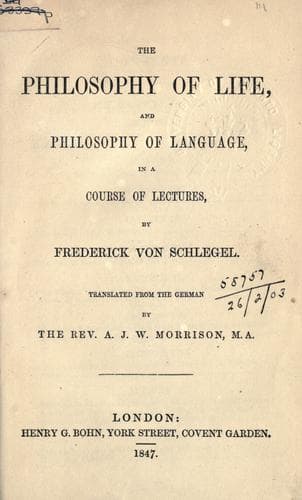
The philosophy of life, and philosophy of language, in a course of lecturesSchlegel, Friedrich von
Philosophy
The philosophy of life, and philosophy of language, in a course of lectures
Schlegel, Friedrich von
Language and languages -- Philosophy; Life; Philosophy
Now, if such a creature, like this terrestrial nature, be of a mixed
constitution, composed of a principle of destruction as well as of a
principle of productive development and progression--if its life be a
constant struggle with death, then it is manifest that only by the same
hand which first formed it, gave it laws, and prescribed its order, can
its wise and divine economy be preserved, and the permanence of the
organic evolution of its whole system be secured, and the outbursts of
elementary dissolution, which are perpetually menacing it, held in check
and averted. If this restraint be once relaxed, if the destructive
energy of the wild elements be once let loose, and free scope given to
their fury--and this globe presents the manifest traces of one such
catastrophe, at least--then this, too, must be regarded as an exception,
and is only explicable by the higher principle of divine permission.
Viewed, however, as the retribution of divine justice on a guilty
world, it forms an exception and a miracle of a peculiar kind, and must
be distinguished from those other extraordinary operations properly
called miracles, wherein, with some saving or quickening purpose, the
Almighty, as it were, raises nature above herself, and takes her out of
her usual course.
In this way, then, we ought unquestionably to refer every thing in the
world to its author and preserver, whether it be conformable to the
usual course and order of nature, or, as an extraordinary phenomenon,
bespeak a higher and more immediate operation of divinity. But, at the
same time, we must never forget that nature itself is a living force
endowed with a capacity of self-development. Nature, indeed, is not free
in the same sense that man is, possessed and conscious of a power of
self-determination and choice; but as all life contains in itself the
germ of a free movement and expansion, and while it expands itself a
hidden and slumbering consciousness begins to stir and awake, so also in
nature, an initiatory or preparatory grade of it, if not fully
out-spoken, is at least indicated. In this respect it may be regarded as
the vestibule of that temple of freedom which in man, the crowning work
of this earthly creation, and made after the divine image and likeness,
stands forth in its full dimensions and proportions. Considered from
another point of view, the sensible world may be looked upon as a veil
thrown over the spiritual world--the light-flowing and almost
transparent robe, and, as it were, in all its parts the significant
costume of the invisible powers. But in no point of view can we rightly
consider nature as properly self-subsisting, or independent of its
Creator, and, therefore, in no case as isolated by itself and apart from
all reference to a superior being. Rather is it a living force, and one,
too, doubly significant, both from within and from without; to which
property an allusion is contained in the simile already employed, of a
Public-domain text, read in full here on John Shaqi.
Reviews
Reviews
No reviews yet
Be the first to share your thoughts on this work.
Elsewhere in the archive
Join the Discussion
Join the discussion
Sign in to leave a comment or review.
Sign InorCreate an account