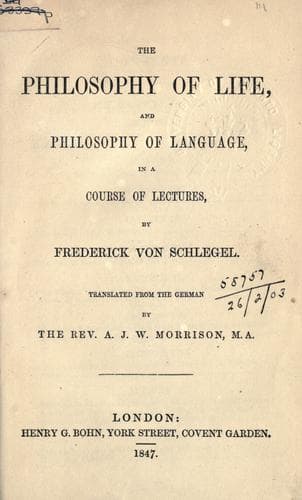
The philosophy of life, and philosophy of language, in a course of lecturesSchlegel, Friedrich von
Philosophy
The philosophy of life, and philosophy of language, in a course of lectures
Schlegel, Friedrich von
Language and languages -- Philosophy; Life; Philosophy
book written both on the inside and the outside. These two ideas, then,
of the free will of man and of the living development of nature, must be
taken as the basis, and serve as the fixed point of every attempt to
ascertain the divine order in nature. On this account we have placed
them in the foreground of the present Lecture, which will, in the main,
be consecrated to such an investigation.
If, now, this demonstration of a divine order in nature seem to contain
nothing less than a kind of Theodicée[29] (so far as man can establish a
justification of God’s ways), I, for my part, must confess that I would
much rather have before my eyes a Theodicée for the feelings, conceived
in the very spirit of love, than any purely rational theory. For such
theories, founded in general on far-fetched hypotheses, subtilly
introduce into nature numberless divine purposes and designs, of which,
however, we are able neither clearly to understand, much less to prove
that they were intended by the everlasting counsels, or even that such
vestiges of a divine purpose are really discernible in the universe. In
this province of speculation we must not be too rigorous in our
determinations, and especially we must guard against systematizing. But,
above all, we can not be too watchful against the fault which so many
reasoners fall into, of transferring into the realm of nature, or of
God, that logical necessary connection which is a part of and connatural
with our rational constitution, and an indispensable aid to our limited
intellectual powers. Such a way of thinking would inevitably lead us to
that most mistaken notion of a blind fate--the phantom of destiny.
On the other hand, how many are the questioning feelings and
perplexities which arise in the human heart at the sight of certain
natural objects. And these even, because they are far from amounting to
doubts and objections, or at least from assuming a definite expression
or a scientific dignity, seem, on that account, only the more loudly to
demand an answer. The mournful cry of some helpless and innocent animal
when killed by man--or in a different category--the hissing of the
venomous serpent; the lothsome mass of maggots in the putrid corpse: all
these are but so many dumb exclamations which, as it were, do but keep
back the question, Are, then, these the productions of the all-perfect
Being--of the Supreme Intelligence?
Public-domain text, read in full here on John Shaqi.
Reviews
Reviews
No reviews yet
Be the first to share your thoughts on this work.
Elsewhere in the archive
Join the Discussion
Join the discussion
Sign in to leave a comment or review.
Sign InorCreate an account