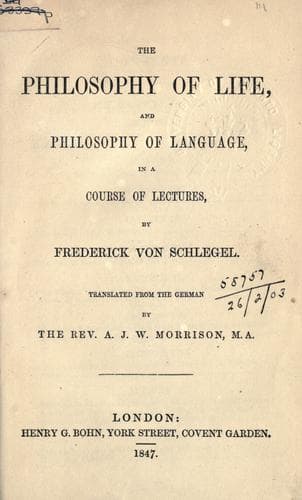
The philosophy of life, and philosophy of language, in a course of lecturesSchlegel, Friedrich von
Philosophy
The philosophy of life, and philosophy of language, in a course of lectures
Schlegel, Friedrich von
Language and languages -- Philosophy; Life; Philosophy
garden of the earth in which the first man was placed, “to dress it and
to keep it,” is, no doubt, called Paradise; and assuredly it was
infinitely more beautiful, more wonderful, purer, and fuller of life,
than the loveliest scenery which meets the eye in the fairest spots of
the earth, and seems to be of an almost celestial beauty. But this is
said only of the immediate inclosure, the immediate habitation of our
first parent; the spot chosen and blessed by God--the garden watered and
surrounded by the four streams. All the rest of nature, the whole of the
world besides, must have ceased at that time to be a Paradise; for,
otherwise, whence could the serpent have come? So that even according to
the simple sense of the expression, “that old serpent,” he was already
there, in the midst of the natural world. And was it not probably a part
of the destination of man--at least, in its natural aspect--that,
setting out from this divine starting-point of a Paradise prepared for
and given to him, he was to go forth and convert the rest of the world
into a similar Eden?
But this destination he did not, however, fulfill, and consequently lost
even this beginning and model of the first Paradise. The names of the
four streams which watered it are indeed still preserved in those
regions of Asia, which even to this day are the richest and most
fruitful, and, according to history, were the earliest inhabited. But
the one source out of which they all took their rise has disappeared,
and no vestige of it remains. With the loss of Paradise all is changed,
not only in man himself, but in the earth as his place of abode.
The way of return out of this bewildered nature, or, if men prefer so to
speak, out of this sunk and degraded, not to say unsound and sickly,
state of the earthly and sensible world (and this way of return is even
the way of obedience to the course of the divine order in nature), is
indicated even by these three grades of its inmost character, its
tendency, and ultimate destination. And in these, and in the final cause
of the whole constitution of things, is contained its true key and
interpretation, as well as the answer to so many questions about nature,
which engage not merely the curious intellect of man, but also attract
the sympathies of his soul, sweeping across it either with dark doubts
and fears, or with bright intimations of life and glorious anticipation.
Public-domain text, read in full here on John Shaqi.
Reviews
Reviews
No reviews yet
Be the first to share your thoughts on this work.
Elsewhere in the archive
Join the Discussion
Join the discussion
Sign in to leave a comment or review.
Sign InorCreate an account