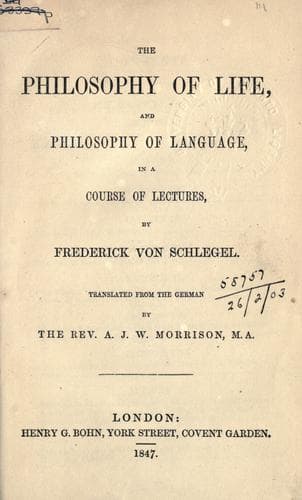
The philosophy of life, and philosophy of language, in a course of lecturesSchlegel, Friedrich von
Philosophy
The philosophy of life, and philosophy of language, in a course of lectures
Schlegel, Friedrich von
Language and languages -- Philosophy; Life; Philosophy
Many writers who, with the best intentions, undertake the task of
indicating the divine wisdom in the existing order of things, and of
defending the ways of Providence against the objections of human
presumption and conceit, generally err by taking too narrow a view of
their subject, and rigorously insisting on some one general principle,
which, by means of very hazardous assertions, they succeed in finding in
the whole and every part of the system of the universe. They leave out
of sight altogether that Mosaic distinction already alluded to, which in
appearance indeed is trifling enough, but yet in reality most
essentially important. Consequently, the good work which they take in
hand, instead of producing that general concurrence and conviction that
it otherwise might, gives rise rather to fresh doubts and objections.
The best solution of all such doubts--the most satisfactory answer to
all such or similar questions or questioning feelings--lies in the final
cause of the present constitution of things, considered as a whole and
in general, and judged of from a regard to its triple character and
triple destination. Now, according to this triple principle, we have, as
already shown, to regard the present system of nature as being primarily
a tombstone raised by Almighty benevolence--a bridge of safety thrown
across the gulf of eternal death--a bridge, however, which we must not
think of as quite so simple, broad, and straight as a bridge made by
human hands, but an animated and ensouled bridge of life, and multiform,
with many arms and branches, and presenting in some parts nothing more
than a narrow footing, where the first false stop precipitates into the
abyss beneath. But secondarily, according to this view, nature is
grounded on and devoted to progress; a wonderful laboratory of manifold,
diversified, and universal reproduction; and lastly, a glorious scale of
resurrection, ascending up to the last and highest summit of terrestrial
transfiguration. Now this laboratory lies in the hidden womb of nature,
while in the noble outward structure of its organic formations this
gradational scale manifests itself with a warning, a prognostication of
the height of excellence to which it eventually leads. But now, if
nature--as, judging from its original design, we may and must
assume--were a Paradise for the blessed spirits of the previous
creation, for the first-born sons of light, then most assuredly has it
not continued so, any more than the first man has remained in the garden
of Eden. No doubt, over a few favored spots of the existing globe, a
rich fullness of ravishing beauty still hovers, awakening in the heart,
as it were, the fleeting images of Paradisaical innocence--dying strains
of a primal harmony--mournful reminiscences of the happy infancy of
creation. For the powers of darkness and hostile spirits broke in upon
the fair beauty of primeval nature, and laid it waste and wild. The
Public-domain text, read in full here on John Shaqi.
Reviews
Reviews
No reviews yet
Be the first to share your thoughts on this work.
Elsewhere in the archive
Join the Discussion
Join the discussion
Sign in to leave a comment or review.
Sign InorCreate an account