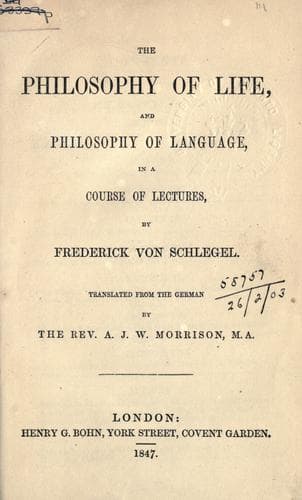
The philosophy of life, and philosophy of language, in a course of lecturesSchlegel, Friedrich von
Philosophy
The philosophy of life, and philosophy of language, in a course of lectures
Schlegel, Friedrich von
Language and languages -- Philosophy; Life; Philosophy
But, in reality and truth, it was out of love that God made the worlds;
and, indeed, out of a superabundant love. This we may well venture to
assert, and even to call it a fact; and that the divine love is also the
final cause, as well as the beginning of creation. A superabundance of
love in God we must, however, call the final cause-ground of creation,
inasmuch as He stood in no need of it; no need of the love of the
creature, nor absolutely of the world itself, or created things. For in
His inmost essence, where one depth of eternal love responds fully and
eternally to the other, He was perfectly sufficient for himself. And yet
it is even so: there is in God the superabundance of love, for He has
created the worlds, and it is the divine will to be loved by His
creatures. For this end and purpose has He created them; and because He
would have their love, He has created them free, and given both to the
pure spirits and to men a free will. The whole secret in the relation
subsisting between the creature, and man especially, and the Creator,
lies even in this great fact, that He has created them out of love, and
requires in return the service of their love. There is, perhaps,
something awful in this requisition, and in the relation thus found to
subsist between a weak and imperfect creature and the infinite and
omnipotent Being. But it is even so: we are really free, and are really
required by God to give him our love. But now a finite and created being
can only be free so far as God leaves him free; and this is only
conceivable in the light I have already set it in by the simile of a
fond mother teaching her babe to walk, and in order to tempt it to make
the first essay with its little limbs, stepping back from it a few
steps, and leaving it a moment to itself. No creature could be free did
not God, in a similar way, leave it to itself, and, after the first
impulse of creation, withhold from it His controlling energy. But if He
did not do so--were He, on the contrary, to act upon His creatures
without reserve, and with the whole infinite extent of his might--then
the liberty of the latter, overwhelmed in His omnipotence, must be
destroyed, as being only possible through the spontaneous limitation of
the divine power, which results from the superabundance of creative
love.
Public-domain text, read in full here on John Shaqi.
Reviews
Reviews
No reviews yet
Be the first to share your thoughts on this work.
Elsewhere in the archive
Join the Discussion
Join the discussion
Sign in to leave a comment or review.
Sign InorCreate an account