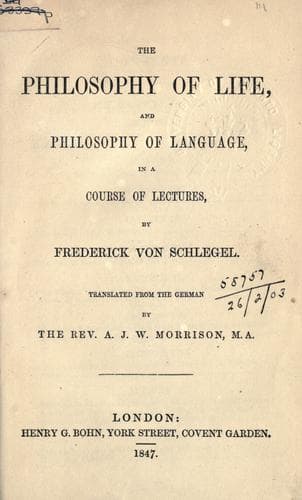
The philosophy of life, and philosophy of language, in a course of lecturesSchlegel, Friedrich von
Philosophy
The philosophy of life, and philosophy of language, in a course of lectures
Schlegel, Friedrich von
Language and languages -- Philosophy; Life; Philosophy
Now we can, it is true, distinguish in the essence or energy of God,
between His intelligence and His will--His omniscience and His
omnipotence; but they can not be absolutely separated from and opposed
to each other, for in Him and in His operations, they, as indeed all
else in Him, are one. It would, therefore, be nothing but a foolish and
unmeaning subtlety to demand, “Why, then, has the Omniscient created
rational beings, of whom He must assuredly have known beforehand that
they would fall and perish?” For it is but a logical illusion, when we
transfer from the human to the divine mind a form of thought fluctuating
between the conceivably possible and the apparently necessary. Man’s
freedom undoubtedly consists in the choice between one possibility and
another, or in that indefinite possibility which subsists half way
between one necessity and another. But God’s freedom is not as man’s: in
Him there is neither contingent possibility nor unconditional necessity.
All in Him is truly actual, living, and positive. His freedom lies even
in the superabundance of His essence--the fact, viz., that He is not
bound by any law of necessity to remain contented with this His own
internal fullness. For otherwise He were a Fate rather than a free God,
and to that conclusion the doctrine of the Stoics consistently enough
arrived at last. Extremely difficult must it ever be, in such a system
and with such a conception of an intrinsically necessary God, and one
bound by this necessity, consistently to account for the creation of the
world, which, in appearance, is so irreconcilable with the idea of the
self-sufficiency of the divine Being. On this account some of the
similarly rationalizing systems of ancient times had recourse to the
ingenious device of ascribing the work of creation to a spiritual being
of an inferior order, and degrading this secondary deity far below the
infinite perfections of the supreme and all-sufficient God. But by this
expedient men did but fall, as is, alas! but too commonly the case, from
one error into another still greater and even more monstrous. It is, in
short, nothing but a mere logical delusion and an illegitimate
transference from our limited faculty of thought to the divine
intelligence, which gives rise to these pernicious doctrines of an
absolute and unconditional predestination, which fundamentally amount
and bring us back to a blind and heathenish fatalism.
Public-domain text, read in full here on John Shaqi.
Reviews
Reviews
No reviews yet
Be the first to share your thoughts on this work.
Elsewhere in the archive
Join the Discussion
Join the discussion
Sign in to leave a comment or review.
Sign InorCreate an account