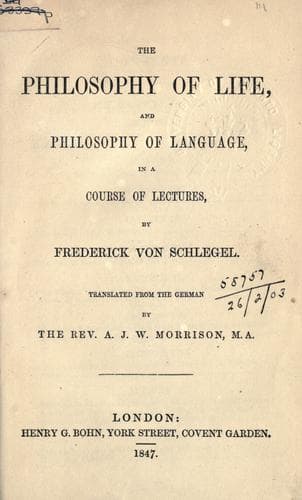
The philosophy of life, and philosophy of language, in a course of lecturesSchlegel, Friedrich von
Philosophy
The philosophy of life, and philosophy of language, in a course of lectures
Schlegel, Friedrich von
Language and languages -- Philosophy; Life; Philosophy
Thus much, as connected with our subject, will be sufficient on the
difficult subject both of the freedom of the pure created spirits and
also of man’s will, as regarded solely from its philosophical aspect,
and without any reference to the moral theory, and solely in relation to
the system of the universe. Difficult, however, is this subject, merely
on one account. The logical illusion, from which springs all error,
strife, and confusion, and which we are too apt to transfer to the
divine mind, is so far innate in the very form of man’s finite
intellect, than even when we have recognized it for what it really is;
yet, so long as we confine ourselves to mere logical reasoning, and are
seduced by its seeming rigor of consequence, we are ever ready to fall
anew into this dangerous error without even remarking it.
In the same way, now, that the existence of free beings follows
naturally from the love of God, as the final cause of creation, so, on
the other hand, the permission of moral evil is a mere result of that
freedom in and through which these created beings have to run their
appointed time. For this freedom, as considered with a reference to God
and futurity, or to the immortality of the soul, is nothing else than
the time of trial and the state of probation itself. But, perhaps it
will be asked, “Why, then, does not God, by one nod of retributive
justice, by one breath of His omnipotence, annihilate forever, as He so
easily might, the whole company of evil and rebellious spirits, together
with their leader, the Prince of this world, and so purify the whole
visible creation, and release external nature from their desolating
influence?” To this the answer is simple and at hand. Man is placed in
this world on his trial and for a struggle with evil, and this warfare
is not yet ended. But by such an annihilation of evil, the living
development of nature would be precipitated in that course which God
originally designed it to advance through, and cut short before the
appointed time of final purification, when, according to His promise, He
will, as Holy Writ expresses it, create new heavens and a new earth, and
make perfect the whole creation.[33]
Man is free, but utterly unripe as yet; and thoroughly incomplete also
is nature, or the sensible world, and material creation; consequently,
the immortality of the soul is the corner-stone and key for
understanding the whole. For the mere beginning of creation is perfectly
unintelligible so long as we do not take into consideration the other
extreme or end--its final completion and ultimate consummation. Just as
the half of human life on this side the grave can not be understood
unless we contemplate, at the same time with it, its second half on the
other side of the tomb, as its complement, and as a necessary element
toward the elucidation of the whole.
Public-domain text, read in full here on John Shaqi.
Reviews
Reviews
No reviews yet
Be the first to share your thoughts on this work.
Elsewhere in the archive
Join the Discussion
Join the discussion
Sign in to leave a comment or review.
Sign InorCreate an account