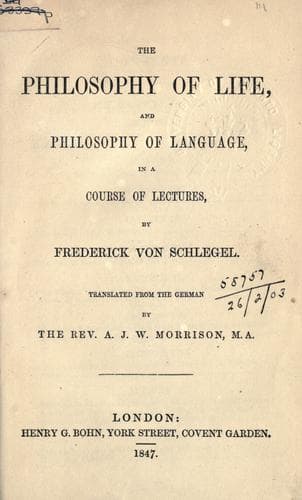
The philosophy of life, and philosophy of language, in a course of lecturesSchlegel, Friedrich von
Philosophy
The philosophy of life, and philosophy of language, in a course of lectures
Schlegel, Friedrich von
Language and languages -- Philosophy; Life; Philosophy
The permission of evil is an immediate consequence of the creation of
free beings. But although it may be regarded as a fact, that God has
created free both the spirits and man, still we must be on our guard how
we introduce into this matter any notion of necessity, and suppose that
God must have made them free, and could not have created any other. For
man is only too prone to transfer his own imaginary conceit of necessity
to the Deity himself, and to feign to see it in Him. This, however, were
a most grievous error; and yet it is one into which men almost
inevitably fall when they adopt either a rigorously systematic or purely
logical view of the matter. Could not God in his omnipotence have
created powers and dominions which, even though they were living
energies and ensouled principalities, should, nevertheless, be without
the property of self-determination and a true liberty, and which would
consequently require some other nature, but similar to themselves, to
rule and direct them? In this sense we read of the spirits of nature,
ensouled elementary powers and living forces, which are described as
being seized and taken possession of by the power of evil, but as
hereafter to be set free by the efficacy of redeeming love, and again
subjected to and united to God. Now, as connected with this subject, it
is deserving of consideration, that in all the declarations and
allusions of the Eternal Truth this present earthly nature is spoken of
as the battle-place of invisible powers, the debatable ground on which
the two armies of good and evil spirits and elements are posted in
hostile array against each other, and perpetually coming into
collision.[35]
Could not God, had such been His pleasure, have created other beings,
and by the fiat of His all-mighty will have raised them at once above
all the dangers of liberty, and enduing them with perfect holiness, and
exempt from all liability to fall, have drawn them to Himself in eternal
love?
I have hitherto, wherever it has been my object to give a clearer and
sharper characterization of the human consciousness by means of a
comparison with the faculties of intellect and will possessed by
superior but created spirits, confined myself to the idea of the pure
spirits, genii or angels. But if it should have been the divine pleasure
to create other spiritual beings with an organic body--one, perhaps, not
like the human, but still of a very noble though animal form, endued of
course with an immortal soul and with a knowledge of God--who is there
in such a case to set limits to the omnipotent will? Now if, as already
supposed, they were created in perfect holiness, and exempt from the
liability to fall, it is easily conceivable how in this respect they
would be higher than frail and imperfect man, and must be regarded as a
part of the spiritual world, rather than as belonging to the human race
or to the existing system of nature.
Public-domain text, read in full here on John Shaqi.
Reviews
Reviews
No reviews yet
Be the first to share your thoughts on this work.
Elsewhere in the archive
Join the Discussion
Join the discussion
Sign in to leave a comment or review.
Sign InorCreate an account