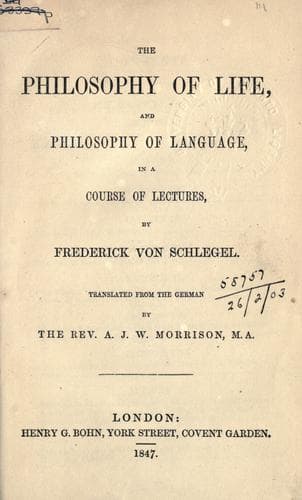
The philosophy of life, and philosophy of language, in a course of lecturesSchlegel, Friedrich von
Philosophy
The philosophy of life, and philosophy of language, in a course of lectures
Schlegel, Friedrich von
Language and languages -- Philosophy; Life; Philosophy
All these are not so much inappropriate and impertinent conjectures and
idle fancies, as calmly mooted questions for explanation, which arise
out of and are suggested by certain traditions and points of revelation.
Lastly, if the Almighty had resolved to create a perfect being, so far
above and before all the other creatures of His will, as to stand next
to Himself, and be, as it were, the mirror and reflection of His own
infinite perfections--and many a word in Holy Writ seems to allude to
something of the kind--then it is not difficult to see how the
already-quoted expression of a soul of God would receive a better sense.
This being, so superior to all other created spirits, must in any case
be regarded as a soul, and for the most part of a passive essence, for
otherwise it would stand too close and near to Deity itself. And it is
manifest, that even here the ever-immeasurable interval which separates
the Creator from the most perfect of creatures must be most carefully
kept in view. And at all events this expression must in no case be
applied to the second or third persons of the Godhead, nor be confounded
therewith, otherwise this designation would not only be false, but
altogether an abomination.
Revelation contains an inexhaustible mine of verities, and I have only
wished, by the way, to call attention to these as yet unexplored
treasures. But it is above all important, for the philosophical point of
view, steadily to insist upon and enforce the truth, that in no respect
can we form a notion adequately grand and lofty, or rich and manifold
enough, of the Creation. The compactly-closed and orderly-arranged
system is almost always the death of truth. So also is that line--which,
however, seems to be a connatural fault in the very form of man’s
faculty of judgment--that straight line between black and white, for
even if it be not radically wrong, it yet leaves much on both sides
unconsidered and ill understood.
Public-domain text, read in full here on John Shaqi.
Reviews
Reviews
No reviews yet
Be the first to share your thoughts on this work.
Elsewhere in the archive
Join the Discussion
Join the discussion
Sign in to leave a comment or review.
Sign InorCreate an account