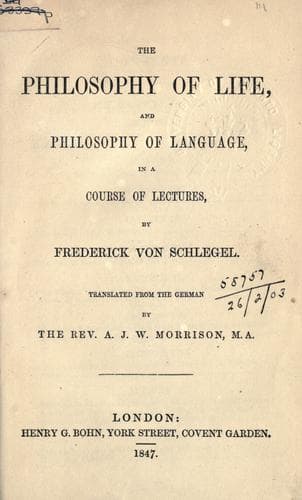
The philosophy of life, and philosophy of language, in a course of lecturesSchlegel, Friedrich von
Philosophy
The philosophy of life, and philosophy of language, in a course of lectures
Schlegel, Friedrich von
Language and languages -- Philosophy; Life; Philosophy
With this impression, I shall allow myself to notice an opinion but
little known, which, moreover, if I had not met with it in writers who,
in this province of inquiry, are of the highest authority, I should
scarcely have ventured to adduce. In this department of spiritual
knowledge, a man would much rather confine himself to the simple primary
truth than call attention to mere opinions. The opinion I allude to is
to be found in St. Jerome, _i.e._, in that very Father who, for
theological judgment, is acknowledged by all to be the first and the
greatest. It was held also by St. Francis de Sales, that holy saint of
spiritual love, and who, even on that account, is so superior to the
many hundreds of the schoolmen before him, as also to so many
ideologists after him. Lastly, it occurred to Leibnitz, who, of all
philosophers, was most possessed of a true and fine intellectual tact to
perceive and discover all the most secret, delicate traits of a great
system, even though most remote in character from his own. But still,
with this array of great authorities, it remains nothing more than a
wholly problematical opinion, on which, as an article of positive faith,
nothing is or ever can be decided. Now this opinion is, that in the
revolt of the rebellious spirits, while those who remained in their
state of innocence and in their allegiance rallied only the closer round
their Creator, a considerable number, fearful and undecided, vacillated
between good and evil, and, as we might justly say, with the weakness of
the human character, remained neutral in the conflict, and thereby lost
their original place in the hierarchy of the heavenly host, without,
however, being counted among the utterly lost. As a fourth authority for
this opinion, I might adduce Dante. He is indeed a poet, but still a
theological poet, and deeply versed in theology, who would never have
arbitrarily devised or invented, or even adopted such a notion, had he
not found it existing among others before him, and had he not been able
to adduce a good and valid authority for it. As a good Ghibelline, he
was, moreover, no friend of neutral spirits, either in this world or the
other; and he passes the most severe sentence upon those beings whom, as
he says, heaven has cast out, and hell would not receive.[36]
Public-domain text, read in full here on John Shaqi.
Reviews
Reviews
No reviews yet
Be the first to share your thoughts on this work.
Elsewhere in the archive
Join the Discussion
Join the discussion
Sign in to leave a comment or review.
Sign InorCreate an account