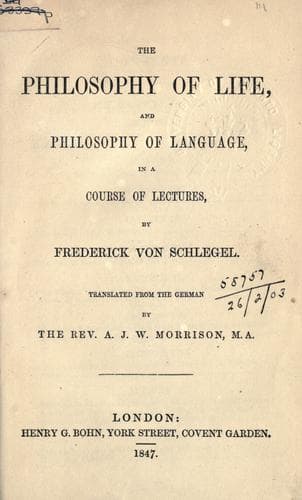
The philosophy of life, and philosophy of language, in a course of lecturesSchlegel, Friedrich von
Philosophy
The philosophy of life, and philosophy of language, in a course of lectures
Schlegel, Friedrich von
Language and languages -- Philosophy; Life; Philosophy
The false science, even that unhuman and godless science which has been
already described, can only be overcome and conquered by the true. The
mere method of negation--which, generally, indeed, is seldom the right
one--is here, too, insufficient for the purpose. And so, in fact, when
clouds of dust darken the air, or swarms of noxious insects fill it, it
may suffice if the goodman of the house shuts to his casement, as he may
lawfully do, even because it is his own; but when the fearful
thunderstorm is lowering in the heavens, the closed window will but
little insure the safety of his dwelling, unless he has more wisely
provided against the danger, by a good lightning-conductor. But what is
that? And how came man first to think of it? Why, by studying the
electrical phenomena, and arriving at a full understanding of its
nature, and so, in obedience to its laws, contriving a counteracting and
diverting agent for the electric current, and converting the natural
action of the threatening element into an instrument of protection. And
just in the same way will a true wisdom proceed in the domain of science
and truth. It is only by a good power, of a like kind and similar action
to its own, that the supremacy of evil can be overcome. Even, therefore,
and to this purport was the earnest warning uttered by the mouth of
Truth Itself against those who, although they sat in Moses’s seat,
neither went in themselves nor suffered others that were entering to go
in.[45]
And what a different picture does Holy Writ set before us in the noble
example of Moses! No doubt the preparation for the work to which he was
to be called, of leading successfully the people intrusted to him by God
out of their Egyptian darkness through the fearful Red Sea and all the
wanderings in the wilderness, to the borders of the promised land, was
even the forty years of solitude among the noble pastoral people with
whom he spent the long period of his exile. But still it is not without
a deep significance that it is written that the daughter of the Egyptian
monarch, having adopted the foundling of the waters, brought him up and
educated him as her own son. So, too, assuredly is it not without design
that it is said so emphatically of him, that he “was learned in all the
wisdom of the Egyptians.”[46] In the first place, we have good reason to
rejoice at and to acknowledge the comprehensive spirit and wide standard
of judgment which Holy Writ here sets up. For whereas it passes a
severer sentence of reprobation on the Egyptians than on any other
heathen nation or people, for their moral depravity, it yet acknowledges
that they possessed a scientific wisdom, which amply rewarded the labor
of its acquisition, while it proved the very errors wherewith in their
extreme corruption they had overloaded it, to be only the more culpable
and deserving of punishment. Shallow and superficial skeptics may,
indeed, as many have already done, avail themselves of such an
Public-domain text, read in full here on John Shaqi.
Reviews
Reviews
No reviews yet
Be the first to share your thoughts on this work.
Elsewhere in the archive
Join the Discussion
Join the discussion
Sign in to leave a comment or review.
Sign InorCreate an account