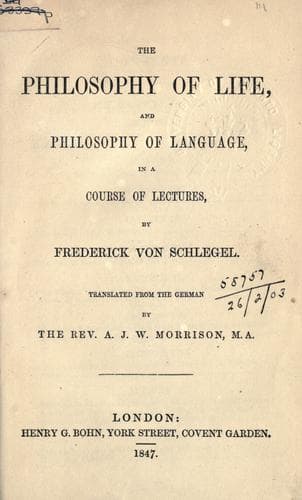
The philosophy of life, and philosophy of language, in a course of lecturesSchlegel, Friedrich von
Philosophy
The philosophy of life, and philosophy of language, in a course of lectures
Schlegel, Friedrich von
Language and languages -- Philosophy; Life; Philosophy
I have so recently noticed, as generally, in all such historical
parallels, nothing more is intended to be asserted than a general
resemblance, which, however, as such, is eminently remarkable. It would
not, perhaps, be difficult anxiously to work out the general resemblance
into points of detail, but such an overwrought assimilation could only
lead to false conclusions and results.
Now that the conflict which our age has to go through is eminently
intellectual is implied simply in the prevailing notion of a _public
opinion_ and its influence. But, at the same time, we must observe, that
in the very notion of opinion, and in the word itself, there is involved
a certain character of extreme vagueness and uncertainty. No doubt that
which man can properly be said to know is extremely limited and
confined. Of very much all that we can have is merely an opinion, and
with that must we be content to put up. Nay, inasmuch as all scientific
certainty admits not of being imparted to all men, very much of that
which we do properly and certainly know is best and most beneficially
set forth to others merely as an opinion, in order that we may not seem
to force their minds to the admission of this higher certainty. And what
is there that the passions of a prejudiced or excited multitude can not
be made to adopt as an opinion, which, if presented to them as a sober
conviction of reason, would never make an impression? So devoid are
they, generally, of that intelligence and accurate knowledge of men and
things which are essential and necessary to the formation of a right
judgment. If, instead of public opinion (which, unquestionably, is a
great power, but which, if it takes a wrong direction, is also a very
dangerous one), the appeal were to be made to a public conscience, this
would be, to my mind, far more impressive and serious. To illustrate my
meaning:--the impression which the events of 1793 made on the general
feeling of all Europe, and the universal movement of discontent which,
among all European nations, preceded the great political catastrophe of
our own days, are instances to which the old maxim, _vox populi vox
Dei_, may, without hesitation, be applied. Such feelings are founded on
a true and higher judgment--often on a correct presentiment of evil and
wrong--even though, as we must admit, that in their utterance more or
less of passion and exaggeration reveals itself, and that individual
prejudices are not unfrequently mixed up with them. But now seldom, in
the ebbing and flooding tide, in the ever-changing course of the stream
of public opinion, flows there aught that truly deserves to be called a
public judgment. And yet public opinion is even that on which, in this
respect, and relatively to the theme of our present Lecture, every thing
mainly and principally turns.
Public-domain text, read in full here on John Shaqi.
Reviews
Reviews
No reviews yet
Be the first to share your thoughts on this work.
Elsewhere in the archive
Join the Discussion
Join the discussion
Sign in to leave a comment or review.
Sign InorCreate an account