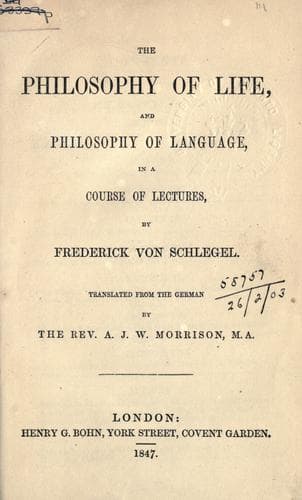
The philosophy of life, and philosophy of language, in a course of lecturesSchlegel, Friedrich von
Philosophy
The philosophy of life, and philosophy of language, in a course of lectures
Schlegel, Friedrich von
Language and languages -- Philosophy; Life; Philosophy
In discussing the theory of consciousness a chasm remained, or, rather,
was intentionally left open, and the present seems the appropriate place
for filling it up and supplying it. The power, or, rather, the faculty
of judgment has not, as yet, had its place assigned it. The reason, with
its immediate subordinates, memory and conscience--the fancy, with its
subordinates, the senses and inclinations, form six faculties of the
inner man, with which the understanding and will make together eight.
The ninth is the living, loving, feeling soul, which, although it be the
center of the whole consciousness, must, nevertheless, be counted as an
independent and peculiar faculty. As for the heart [_Gemuth_]--as some
peculiarly designate the collective sum of the tender, moral emotions of
the soul, and which, at any rate, must be carefully distinguished from
the conscience, and also from love--it is, however, a kind of
application of the triple relation and function of the soul rather than
an independent faculty. But the tenth faculty, which completes the whole
cycle and theory of the human consciousness, and which may be regarded
as its crown and perfection, is the judgment, or, in other words, the
judging mind [_geist_].
But now, if this term judgment be understood purely in a logical sense,
as that process of thought which forms combinations and deductions, and
by means of which we ascribe to a subject A a predicate B, this would
fall very far short of the signification in which I here intend it to be
taken. Moreover, it would be, in truth, quite a superfluous task to
separate this cogitative relation, or this relative cogitation, from
the other logical functions of the understanding, and to make of it a
special and independent faculty. The judgment is something higher than
this mere coupling in the thought of some special A with some general B.
Understanding is the cognition of spirit and of that which it has
uttered; and judgment is the decision between two things understood, or
the “discerning of spirits.” Of how great a multitude of intellectual
relations does a scientific or even an artistic judgment imply the
coincidence and concurrent action! And yet these are merely private
judgments, which involve an assenting feeling in the individual, but
beyond that can not pretend to any valid authority. In practical life
the judicial function in the state alone furnishes an adequate standard
for estimating the high rank which the faculty of judgment holds as the
center of the human consciousness. For, in the deliberative sentence of
the judge there is comprised both the mature art of the
understanding--which has taken due cognizance of the matter, and
impartially discerned between two objects equally well understood--and
also a determination of the will: for, though the actual carrying into
effect--that which properly and peculiarly constitutes a willing--belong
not to, but is independent of, the judge’s office, still the conclusion
Public-domain text, read in full here on John Shaqi.
Reviews
Reviews
No reviews yet
Be the first to share your thoughts on this work.
Elsewhere in the archive
Join the Discussion
Join the discussion
Sign in to leave a comment or review.
Sign InorCreate an account