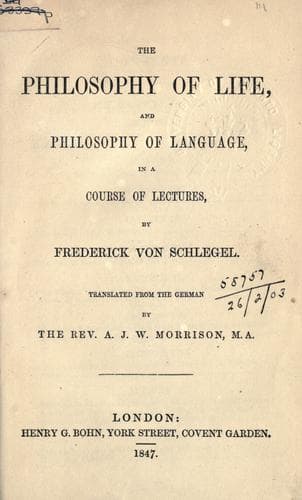
The philosophy of life, and philosophy of language, in a course of lecturesSchlegel, Friedrich von
Philosophy
The philosophy of life, and philosophy of language, in a course of lectures
Schlegel, Friedrich von
Language and languages -- Philosophy; Life; Philosophy
This reference of all judicial sentences to, and their foundation in a
divine authority, is an idea which was not unknown even to the
republican states of antiquity, as is evident from the way they
expressed themselves on the irrefragable sanctity of the laws and the
inviolability of the supreme judicial power, and also in the maxims
which they practically advanced on this subject. They honored herein a
higher and a diviner principle, of which, however, in theory they
possessed no clear and perfect knowledge, though in practical life they
were taught by a correct feeling of sound reason and the natural
conscience accurately enough to recognize and steadily and distinctly to
respect it. With us still more generally is it become an admitted
doctrine that all sovereignty and kingly power is of God, and that all
obedience to the laws and to the supreme authority in the state rests
ultimately on a divine foundation and sanction. If very recently men
were for a while disposed to argue that political institutions must be
founded on the reason and its unconditional liberty, yet bitter
experience quickly convinced them of their error, and it was soon fully
refuted by the convincing argument of actual fact. And, accordingly,
theory has for the most part reverted to a right principle, and
recognized the divine authority as the true foundation of political
authority.
But the principle being thus generally recognized, it is, I think, still
necessary to distinguish with care and accurately to define in what
sense the supreme ruler of the state is the vicegerent of God. The
indefinite titles which are assumed by Eastern despots have always been
alien to the habits of the West. But it is not enough to avoid such
exaggerated titles of honor, if, nevertheless, the appeal to divine
right be made so very vaguely, and simply in general terms to God
himself. In His absolute essence, God is wholly inconceivable; it is
only in his operations on man and nature, and in His relations to the
human race, that we can at all think precisely of Him. It is only as
Creator of the world, as the Lawgiver of nature, or as the Benefactor
and Redeemer of mankind, and so forth, that we can form a clear and
distinct notion of the Godhead.
Public-domain text, read in full here on John Shaqi.
Reviews
Reviews
No reviews yet
Be the first to share your thoughts on this work.
Elsewhere in the archive
Join the Discussion
Join the discussion
Sign in to leave a comment or review.
Sign InorCreate an account