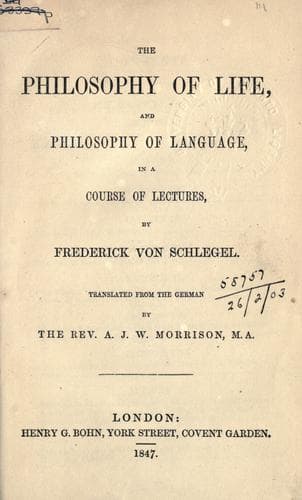
The philosophy of life, and philosophy of language, in a course of lecturesSchlegel, Friedrich von
Philosophy
The philosophy of life, and philosophy of language, in a course of lectures
Schlegel, Friedrich von
Language and languages -- Philosophy; Life; Philosophy
of a positive judgment implies the existence of the first determining
motive of the will. In this one act of judging, therefore, there is
contained both functions of the mind [_geist_], understanding and
willing; and as the loving soul is the center of the consciousness, so
the judging mind, or spirit, is the highest of all its operations.
In the Book of Truth there is a sentence which admits of application
here. “There is none good,” it is there written, “but one, that is,
God.” However harsh and severe this judgment may sound at the first
hearing, still, upon a little reflection, we shall see ample cause to
admit its justice. Man is not wholly and purely good; at the very best
he is not free from faults, and more or less of imperfection cleaves to
all that he does or is. And even granting that a man might be found
devoid of all admixture of imperfection, and quite faultless and
thoroughly good, still he was not so always and from the first. And even
if any should here urge that the angels, who have continued such as they
were originally created, were good from the beginning, we must remember
that, at least, they are not good in and by themselves, but that, that
they are good, comes from God, who is the source of all goodness. Now,
just in the same sense can we also say, Who judges rightly? There is
none that judges rightly but one, _i.e._, God. He is Himself the truth;
and, therefore, He alone has the standard of truth in Himself, and all
truth has its ground and principle in Him alone. Every individual
judgment and decision, in all important matters, has its ground, either
mediately or immediately, in this divine basis, and its rectitude must
be estimated according to this standard. But this latter condition need
not make us foolishly anxious, for nothing impossible is required of us
by God; and this requisition, like every other which He lays upon man,
is modified by, and adjusted to, the measure of human finiteness. The
conscientious judge, who, after a patient investigation of the cause as
it is laid before him, and after a careful weighing of all the possible
reasons and motives, nevertheless errs, or is deceived by a rare
coincidence of circumstances, stands, nevertheless, exonerated, even
though he should have passed an unjust sentence, and have had the
misfortune to condemn the innocent. Although, when he becomes aware of
it, the thought must be painful enough to his own feelings, yet who, in
justice, can reproach him merely because he was not omniscient? He who,
in thought, in science, and in faith, adheres to this divine
foundation--the best and most certain that he can find, or that is any
where offered to him, may rest calm and composed; he has done the utmost
that lies in his power. He alone, who makes a bad use of what he has and
what has been given to him, like an unjust steward, need fear to give an
account of his stewardship.
Public-domain text, read in full here on John Shaqi.
Reviews
Reviews
No reviews yet
Be the first to share your thoughts on this work.
Elsewhere in the archive
Join the Discussion
Join the discussion
Sign in to leave a comment or review.
Sign InorCreate an account