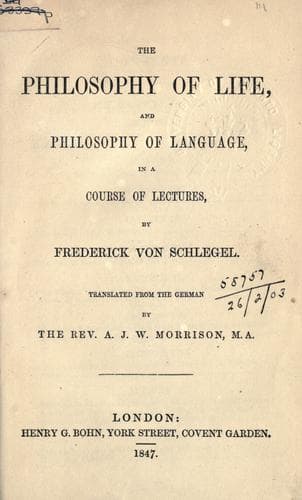
The philosophy of life, and philosophy of language, in a course of lecturesSchlegel, Friedrich von
Philosophy
The philosophy of life, and philosophy of language, in a course of lectures
Schlegel, Friedrich von
Language and languages -- Philosophy; Life; Philosophy
Now, as not only the annihilation of the race of giants in the universal
deluge, with which our sacred history opens, and to which the ancient
traditions of almost every people allude, more or less directly, but
also the partial overthrow of a single nation, the tragical closing
catastrophe of particular ages, is, as it were, a prelude of the final
judgment of all nations and peoples of the earth at the end of time; so,
on the other hand, the original corruption of the primal lie is
propagated as an hereditary evil from millennium to millennium, and from
century to century. For even now, may many a fertile spot, the seat of a
happy and united community in the midst of prosperous times, and of
peace unbroken at home or abroad, be considered, if not a garden of
innocence, still the blissful dwelling of peace and quiet. But into
these happy precincts the evil spirit of untruth and discontent ever and
anon steals, to repeat over again in the history of the human race the
same scene of temptation which marked its commencement. Upward and
downward, and in a twofold direction, does the lying spirit of strife
ply his seductive arts. Now, on the one side, he whispers in the ear of
the rising generation, “That is the true knowledge and the real science
which men are most anxious to withhold from you; but seek first of all
to be free--shake off this unworthy spirit of slavish obedience, then
shall all that is noble and intellectually great be at once yours. In
this way, and thus only, was it attained by the great and good in
ancient times.” But, on the other hand, he directs himself to the
individual invested with authority; and if the potentate be unrighteous,
his ear is already more than half open--and even if he be upright,
still, as a man, he is not always inaccessible to such whisperings.
“Why,” he insidiously asks, “dost thou draw back so fearfully before
that which the people call their rights? These are nothing but childish
notions which the school-boy may do well to declaim about, but
practically they are worthless and unreal; no one means them
seriously--the whole world puts no faith in this comedy. Rule your
subjects with an iron hand, that is all they know how to respect; nay,
they even admire the bold spirit that defies them, and they will
suppliantly reverence thy greatness of mind and strength of character
if, betraying no infirmness of purpose, you boldly and sternly encroach
upon or disregard all their pretended rights and privileges. If only
your sovereignty be solidly established from within, and well rounded
from without, then, besides a great name with posterity, you will also
secure to yourself the present enjoyment of very great and solid
advantages.”
Public-domain text, read in full here on John Shaqi.
Reviews
Reviews
No reviews yet
Be the first to share your thoughts on this work.
Elsewhere in the archive
Join the Discussion
Join the discussion
Sign in to leave a comment or review.
Sign InorCreate an account