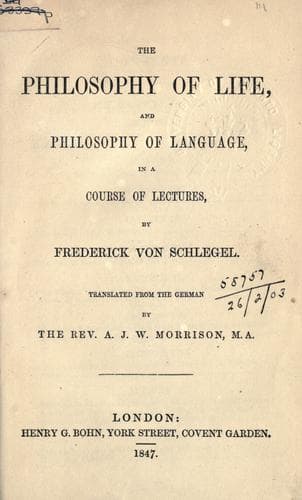
The philosophy of life, and philosophy of language, in a course of lecturesSchlegel, Friedrich von
Philosophy
The philosophy of life, and philosophy of language, in a course of lectures
Schlegel, Friedrich von
Language and languages -- Philosophy; Life; Philosophy
Thus, then, do we every where observe a strange internal correspondence
and affinity between the several aberrations of our age. Here the
remotest mental extremes, which externally seem to repel each other,
suddenly converge at the same point of delusive light, or rather of
brilliant darkness. Instances of this correspondence startle us where we
least expect to meet with them. An English poet,[10] perhaps the
greatest, certainly the most remarkable poet of our age, in his tragic
delineation of the oldest fratricide, has portrayed the prime mover of
this deed, the enemy of the human race, and the king of the bottomless
pit, as the bold censurer of the divine order of things, and the head of
all discontented spirits, and leader of the opposition of the whole
creation. In this light he has painted him with unparalleled boldness,
and with such moving and astonishing truthfulness, that all previous
descriptions by the greatest poets seem but arbitrary and unreal
phantoms when compared with this portrait, which was evidently a
favorite sketch, for the author’s secret partiality betrays itself in
the skill and pains with which he has lavished on this dark figure all
the magic colors of his fancy. Thus, then, in this poetic creation, the
same hostile principle--the same absolute, _i.e._, evil spirit of
negation and contradiction that forms the consummation of the errors of
German philosophy, notwithstanding its abstract unintelligibility--is
enthroned amid the disordered system. And so, by a strange law of
“pre-established harmony,” the anti-Christian poet and these
anti-Christian thinkers unexpectedly meet together at the point of a
spurious sublimity. In any case, however, this last instance forms the
third stage of idealistic confusion, and certainly the last grade of
scientific atheism.
Public-domain text, read in full here on John Shaqi.
Reviews
Reviews
No reviews yet
Be the first to share your thoughts on this work.
Join the Discussion
Join the discussion
Sign in to leave a comment or review.
Sign InorCreate an account