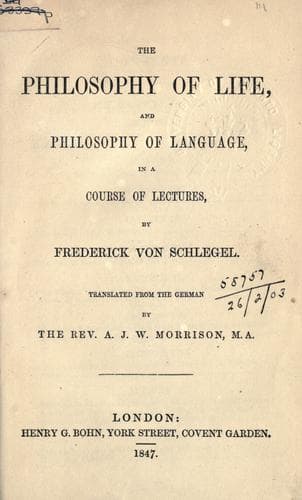
The philosophy of life, and philosophy of language, in a course of lecturesSchlegel, Friedrich von
Philosophy
The philosophy of life, and philosophy of language, in a course of lectures
Schlegel, Friedrich von
Language and languages -- Philosophy; Life; Philosophy
The philosophy of life, then, can not be any mere absolute philosophy of
reason. And as little can, or ought it to be purely and absolutely a
philosophy of nature; not, at least, an exclusive one, that is, exactly
such and nothing more. Such a philosophy of nature may, indeed, in its
physiological aspect, possess unequaled scientific wealth, and be full
of profound and ingenious thoughts. But still the right principles and
the regulative ideas of human life can never be deduced from it easily,
and without having recourse to forced constructions. For even man is, in
his life, something higher than nature; even he is something more than a
mere physical being. Still less possible, then, were it, from such a
philosophy of nature, to derive, establish, and to render clear and
intelligible the idea and being of God--the pervading reference to whom,
however, makes man what he is. The idea of God deduced from such a
source alone would, and indeed could only be, some great final cause of
the system of nature.
Neither the conclusions of sound reason, and least of all those of the
conscience--no, nor even dialectic itself (so far as it is profitably
employed, by the knowledge of it being made available for the detection
of error), nor physical science, when cultivated in a noble and lofty
spirit, ought in any way to be excluded from the borders, or even the
very domain of philosophy. On the contrary, she may, in her own peculiar
way, adopt them all, and, giving them a more extensive sense and spirit,
employ them for her own higher aims. In its primary and most essential
respects, the philosophy of life is a thoroughly human science. It is
nothing less than the cognition of man. Now, even on this account, and
because it is only by means of his all-pervading relation to God that
man stands above nature and is something superior to a mere physical
being, and something higher, too, than a mere rational machine,
therefore is the philosophy of life actually and in fact a true
philosophy of God. The philosophy of life attains this high dignity
beyond a mere philosophy of reason, or of nature, simply on this
account--that the supreme life and the ultimate source of all other
degrees of life is even God. Now this Supreme Life, which has its life
in itself, is the subject of my present disquisitions. For it is even
with the correct and complete notion of this Supreme Life that the
Spirit of Truth first enters the human consciousness; and then, in the
inner world of man, which before was “without form and void,” that light
begins to shine which never shall become darkness, and of which even
this Spirit of Truth has said “that it was good.” This divine but
initiatory illumination is the first step in that progressive
development of the internal light and truth in human life and
consciousness, and which, as starting from this point and passing
through its successive stages of advancement, it will be our object to
trace in the last seven of the present Lectures.
Public-domain text, read in full here on John Shaqi.
Reviews
Reviews
No reviews yet
Be the first to share your thoughts on this work.
Elsewhere in the archive
Join the Discussion
Join the discussion
Sign in to leave a comment or review.
Sign InorCreate an account