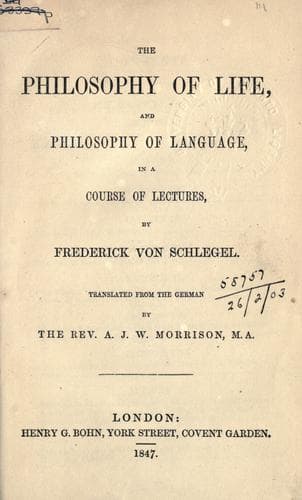
The philosophy of life, and philosophy of language, in a course of lecturesSchlegel, Friedrich von
Philosophy
The philosophy of life, and philosophy of language, in a course of lectures
Schlegel, Friedrich von
Language and languages -- Philosophy; Life; Philosophy
Philosophical thought and knowledge, with that diversity of illustration
and variety in method which follows from its universality, is, in this
respect, somewhat in the same case with poetry. Of all the imitative
arts poetry alone embraces, and by its nature is intended to embrace,
the whole man. It is, therefore, free to borrow its similes or colors,
and manifold figurative expressions, from every sphere of life and
nature, and to take them now from this, now from that object, as on each
occasion appears most striking and appropriate. Now, no one would think
of prescribing unconditionally to poetry, and compelling her to take all
her similes and figures either from flowers and plants, or from the
animal world, or exclusively from any one of the several pursuits of
man--from the sailor’s life, for instance, or the shepherd’s, or the
huntsman’s--or from any of his handicrafts or mechanical arts. For
although all such similes, and colors, and expressions, appropriately,
introduced, are equally allowable in every poetical composition, and
none of them need be rejected, still the exclusive use of any one class
of them as a law would hamper the free poetic spirit and extinguish the
living fancy. In the same way, philosophy is not confined to any one
invariable and immutable form. At one time it may come forward in the
guise of a moral, legislative, or a judicial discussion; at another, as
a description of natural history. Or, perhaps, it may assume the method
of an historical and genealogical development and derivation of ideas as
best fitted to exhibit the thoughts which it aims at illustrating in
their mutual coherence and connection. On other occasions, perhaps, it
will take the shape of a scientific investigation of nature--of an
experiment in a higher physiology--in order to test the existence of
the invisible powers which it is its purpose to establish. Or again, by
the employment of an algebraic equation, or of a mathematical form
(which, however, it regards as nothing more than a symbol and visible
hieroglyphic for a higher something that is invisible), it will,
perhaps, most conveniently attain to its loftier aim. Every method and
every scientific form is good; or, at least, when rightly employed, is
good. But no one ought to be exclusive. No one must be carried out with
painful uniformity, and with wearying monotony be invariably followed
throughout.
Public-domain text, read in full here on John Shaqi.
Reviews
Reviews
No reviews yet
Be the first to share your thoughts on this work.
Elsewhere in the archive
Join the Discussion
Join the discussion
Sign in to leave a comment or review.
Sign InorCreate an account