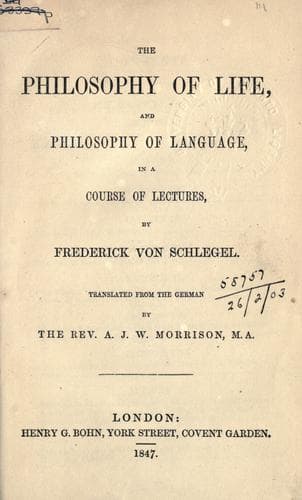
The philosophy of life, and philosophy of language, in a course of lecturesSchlegel, Friedrich von
Philosophy
The philosophy of life, and philosophy of language, in a course of lectures
Schlegel, Friedrich von
Language and languages -- Philosophy; Life; Philosophy
Let us now, for a moment, revert to the old scholastic forms and the
designations usually given in the schools to the several philosophical
sciences, and compare with them the division on which our present
disquisitions are based. We might, in this respect, say that the first
five sections of our treatise have been exclusively devoted to
psychology; though not indeed in the ordinary narrow sense of the word,
but in one far more extensive, and embracing the whole universe.
According to this wider extent and signification of psychology, we have
considered the soul relatively, first of all, to the whole of philosophy
and its several systems; secondly, to moral life; and, lastly, to
revelation, to nature, and to God Himself. The three following Lectures
were devoted to an examination of the divine order of things in the
several spheres of existence, and to the indications of a ruling
Providence discoverable therein. They constitute, therefore, a species
of theology; but one, however, empirically conceived and historically
worked out from observations in nature and in history, not only in the
annals of the external world, but also in the spiritual history of the
progressive terms in the development of truth. Such a theological essay
exactly corresponds to that notion we so lately advanced, of an applied
or mixed science of theology as the peculiar sphere for this part or
branch of philosophy which concerns itself with the doctrine of the
supreme essence, and the right understanding thereof.
Now if, in compliance with olden forms of division and a scholastic
phraseology, it be necessary to deliver a scheme of ontology as the
philosophical science and cognition of really existent things, and also
of their true and real essence, it is clear that such is only
conceivable and possible by means of such an applied theology. For how
can things be truly real, and how can they as such be known in their
inmost essence, except so far as they have their existence and
determination in God, and, in this respect, admit of being known by us?
Public-domain text, read in full here on John Shaqi.
Reviews
Reviews
No reviews yet
Be the first to share your thoughts on this work.
Elsewhere in the archive
Join the Discussion
Join the discussion
Sign in to leave a comment or review.
Sign InorCreate an account