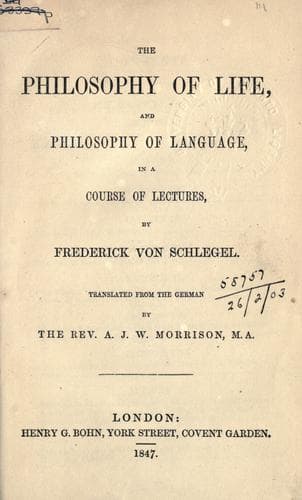
The philosophy of life, and philosophy of language, in a course of lecturesSchlegel, Friedrich von
Philosophy
The philosophy of life, and philosophy of language, in a course of lectures
Schlegel, Friedrich von
Language and languages -- Philosophy; Life; Philosophy
In any case, however, the name of _natural_ theology, which ever and
anon we still hear applied to the philosophical cognition of the Divine
Being and His existence, ought carefully to be avoided. Such a
designation is based on a thorough misconception and total inversion of
ideas. Every system of theology that is not supernatural, or at least
that does not profess to be so, but pretends to understand naturally the
idea of God, and regards the knowledge of the divine essence as a branch
of natural science, or derives the idea simply from nature, is even on
that account false. Missing and entirely mistaking its proper object, it
must, in short, prove absolutely null and void. Properly, indeed, this
inquiry needs no peculiar word nor special division and scientific
designation. The name generally of philosophy, or specially of a
philosophy of God, is perfectly sufficient to designate the
investigation into science and faith, and their reciprocal
relation--their abiding discord, or its harmonious reconciliation and
intrinsic concord. And this is properly the point which is here in
question; it forms the essential part of the topic which we have at
present to examine.
The internal schism in the faith itself I formerly excluded from our
inquiry, as not lying properly within the limits of philosophy, and
belonging to a higher tribunal. I at the same time expressed my
conviction that God alone could universally and totally reconcile it. By
this, however, I would not by any means wish to be understood as
asserting that works on this subject, written with a thorough knowledge
of historical facts, and in a luminous and instructive style, can not
contribute much to the refutation of error. Works of this nature may, in
their degree, tend to bring about a mutual approximation of sentiment.
For they serve to elucidate and clear up points which, even though they
do not involve the essential articles of positive belief; do,
nevertheless, greatly and extensively co-operate in keeping alive a
mutual spiritual alienation and estrangement of mind. The great merit of
treatises of this kind, when composed with high intellectual powers and
in that noble spirit which is at once just and desirous of peace, must
not in any case be denied or depreciated. Nevertheless, it is idle to
pretend that the influence of such essays, whether greater or less, is
not confined to a limited sphere, extending to a few individuals, or at
most to classes.
Public-domain text, read in full here on John Shaqi.
Reviews
Reviews
No reviews yet
Be the first to share your thoughts on this work.
Elsewhere in the archive
Join the Discussion
Join the discussion
Sign in to leave a comment or review.
Sign InorCreate an account