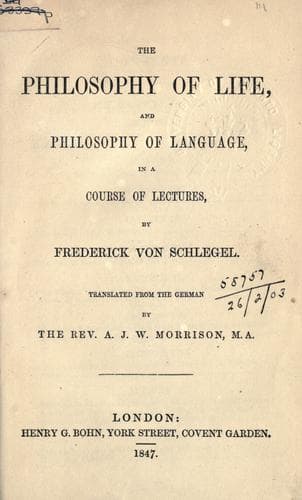
The philosophy of life, and philosophy of language, in a course of lecturesSchlegel, Friedrich von
Philosophy
The philosophy of life, and philosophy of language, in a course of lectures
Schlegel, Friedrich von
Language and languages -- Philosophy; Life; Philosophy
In the history, too, of the development of the Grecian mind we discover
a similar doctrine advanced in one of its latest epochs. The
Neo-Platonists were very well acquainted with this doctrine and idea of
a divine trinity; as, indeed, it may also be traced in the still earlier
writings of Plato himself. How far the expressions and formularies
employed by the former writers scientifically to convey this idea were
perfect and correct is a question which does not concern us at present
to inquire. Moreover, the determination of it would carry us far beyond
our proper limits, inasmuch as its exact solution would require a nice
and accurate classification of the several writers and systems which
belong to this school. It is, however, sufficient to remark that this
profound metaphysical school of the Neo-Platonists, which reckoned among
its adherents the Emperor Julian, stood in direct and hostile collision
with Christianity. To adapt to the purpose of their opposition the old
Grecian mythology, a faith in which had sensibly declined even among the
masses, they attempted to mold it according to their own views and
notions, into such a theological shape and direction as would make it
more closely resemble the Indian. By this means they believed it
possible to revive and reanimate the popular faith. But, even if their
ulterior view and their whole object and actuating motive had not taken
a direction so decidedly hostile to the truth, still their enterprise,
even as such, could not but miscarry. No doubt the mythology of Greece,
in its earliest times and original shape, did contain, in some of its
less prominent and more hidden passages, esoterically interpreted, a few
symbolical doctrines and somewhat theistic ideas, as many a profound
examiner of it, in modern times, has recognized and demonstrated. But,
notwithstanding all these traces, which we must regard as the remains of
an older tradition of the primary knowledge and full revelation
belonging to primeval times, still, in subsequent ages, the Grecian
mythology had, on the whole, assumed exclusively and pre-eminently a
poetic development and form, which even subordinated to itself that
political tendency which in so many of its details is so strong. It was,
therefore, nothing less than an absurd and inconsistent attempt to try,
so late in the day, to metamorphose this beautiful world of fable into a
factitious theory of metaphysics, and a colossal system of mysticism,
after the manner and fashion of the Indian. Accordingly, like every
other attempt that is fundamentally false and directly opposed to the
spirit of the age, it passed away at last, without leaving a trace of
its influence.
Public-domain text, read in full here on John Shaqi.
Reviews
Reviews
No reviews yet
Be the first to share your thoughts on this work.
Elsewhere in the archive
Join the Discussion
Join the discussion
Sign in to leave a comment or review.
Sign InorCreate an account