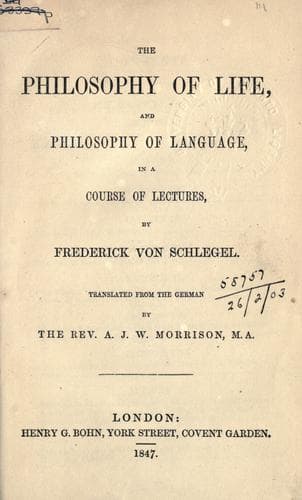
The philosophy of life, and philosophy of language, in a course of lecturesSchlegel, Friedrich von
Philosophy
The philosophy of life, and philosophy of language, in a course of lectures
Schlegel, Friedrich von
Language and languages -- Philosophy; Life; Philosophy
This inclination to the poetic aberration of polytheism and a
deification of nature, so universally prevalent in the heathen antiquity
of the West, renders it easily conceivable why, in the first and Jewish
portion of written revelation, such great stress is laid pre-eminently
and primarily on the oneness of the living God. All other
expressions--such as that of the eternal creative Word, of the
life-giving Spirit of God--are, as it were, but allusions full of hidden
meaning for the more clear-sighted and profounder inquirers. How
numerous, nevertheless, such indications are; how frequent the reference
to three powers or persons--the time, energy, and property of the one
Supreme Being--an allusion to which is contained even in the different
Hebrew names of the Godhead, is known and acknowledged, even by those
who would, if they could, deny it, both to themselves and others.
The tradition of the Jews, which, lying without the strictly-defined
body of Scripture, yet proceeds concurrently with it, while it possesses
of itself no authority, is, nevertheless, a very useful though too much
neglected source of illustration for the sacred volume. Now, in the
Talmud the doctrine and notion of the divine trinity is expressed quite
fully and distinctly, and without reserve; although in the mode and
manner of conceiving it there is much that is both false and
objectionable.
In that second portion of revelation with which our present era
commences, together with the fulfilling and perfection of the object of
faith, this supreme science is brought prominently and clearly forward.
No doubt a certain caution and degree of reserve on this doctrine of the
Trinity are distinctly visible in the earliest teaching and statements,
so long as the preaching of the new faith was confined within the Jewish
nation, on whose mind the idea of the oneness of God was still deeply
imprinted, even though, like every other principle of their religion, it
was ill understood and had long ceased to be embraced with a living
energy, being taken merely in the dead letter. But ere long this thin
veil was also removed from the All-holy One, and the great mystery of
faith set forth as the introduction to the fourth and last Gospel. From
the latter I have accordingly borrowed that designation of this great
mystery which is even the most appropriate to science; of the supreme
life which is itself omnipotence, of the eternal word which is
ominisence, and of the uncreated light which is the All-holy.
Public-domain text, read in full here on John Shaqi.
Reviews
Reviews
No reviews yet
Be the first to share your thoughts on this work.
Elsewhere in the archive
Join the Discussion
Join the discussion
Sign in to leave a comment or review.
Sign InorCreate an account