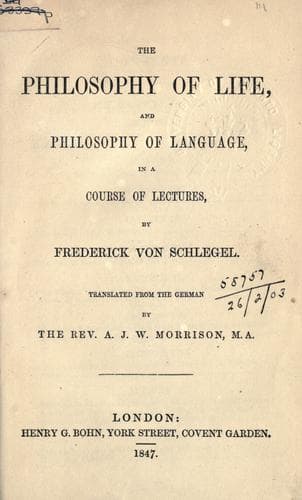
The philosophy of life, and philosophy of language, in a course of lectures — John Shaqi
The philosophy of life, and philosophy of language, in a course of lecturesSchlegel, Friedrich von
Philosophy
The philosophy of life, and philosophy of language, in a course of lectures
Schlegel, Friedrich von
Language and languages -- Philosophy; Life; Philosophy
This general description, it must be confessed, is very far from being
an adequate explanation of the matter, and at best does but imperfectly
convey our meaning. But perhaps a different line of thought, however
bold and hazardous it may seem, may bring us far more simply to the
point at present in view--a more accurate description, namely, of the
peculiar property of the human mind, and of the characteristic feature
which distinguishes man from other beings equally finite, but endowed in
the same manner with consciousness. That the rational soul, or the
reason, distinguishes him from the brutes, is a remark common and trite
enough. But this is only one aspect of the matter: and must we always
cast our looks downward, and never upward? What I mean is this:
supposing that there are other created spirits and finite intelligences
besides men, might not the comparison of their purely spiritual
consciousness with man’s serve, perhaps in an eminent degree, to
elucidate the distinctive properties of the human consciousness in that
other aspect which is too commonly neglected? I am far from intending to
make this matter a subject of investigation in the present place. I take
it merely as an hypothesis, warranted, indeed, by universal tradition,
and solely as an aid to elucidate the matter in hand. Universal,
however, I may well call this tradition, since, agreeing in the main
with what Holy Writ asserts, the oldest and most civilized nations of
antiquity (among whom I need only mention the Egyptians, and especially
the Persians and the Hindoos) have admitted, as a well-established fact,
the existence of such finite intelligences and created spirits,
invisible indeed to man, but not altogether alien to him. And as for the
Greeks and Romans, if occasionally they allude to the genius of Socrates
as something strange and singular, this was only because the wise
Athenian spoke of this subject in peculiar language, and referred to it
more habitually than was the wont of his countrymen and cotemporaries.
Otherwise it was the general belief, both of Greeks and Romans, that
every man has his guardian spirit or genius. Now this hypothesis being
once admitted to be possible, let us inquire in what light were these
ancients accustomed to regard, and what ought we to conceive of the
peculiar nature of these spiritual beings in conformity with the
representation of so universal a tradition?
Public-domain text, read in full here on John Shaqi.
Reviews
Reviews
No reviews yet
Be the first to share your thoughts on this work.
Join the Discussion
Join the discussion
Sign in to leave a comment or review.
Sign InorCreate an account