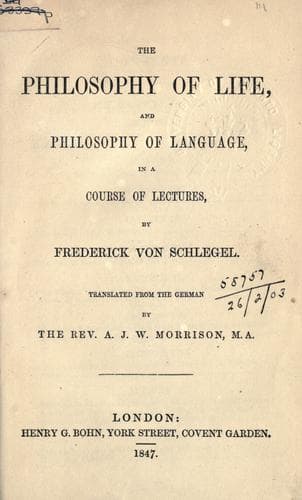
The philosophy of life, and philosophy of language, in a course of lecturesSchlegel, Friedrich von
Philosophy
The philosophy of life, and philosophy of language, in a course of lectures
Schlegel, Friedrich von
Language and languages -- Philosophy; Life; Philosophy
The complete notion or ideal scheme of pure faith, in its organic union,
co-operation, and true relation with all higher and with all natural or
earthly science, must be conceived of and sketched in agreement with the
triple principle of the human consciousness, according to which it is
divided into spirit, soul, and sense. At least it is in this way that it
can most easily be made clear, and being accurately apprehended in its
essential properties and nature, is kept distinct from all foreign
elements and adscititious matters. But infidelity, and that doubt and
absence of harmony from which it takes its rise, as well as that error
which results from it, have their seat in the fourfold consciousness.
These all owe their origin to that disunion in which the mind was
involved by the Fall, and which manifests itself principally in the
dissension which subsists between Fancy and Reason, and eventually
destroys all harmony and co-operation between the Understanding and the
Will. For this twofold schism in the human consciousness is the source
of all philosophical error and of its various false systems. And this
scientific error again, so soon as it attains to a practical utterance,
and in a living form enters into or interferes with life, becomes
infidelity.
Originally, however, the consciousness was not thus rent by dissension.
Throughout, in its triple principle of sense, soul, and spirit,
prevailed one living, harmonious action. Now, in this its natural state,
the soul must be regarded as the principle of faith. And this is a point
especially to be borne in mind. It is, however, too often forgotten. And
consequently the faith, or, rather (for we are not speaking at present
of the subject-matter so much as of the mental act), the believing, is
in an external manner derived very incompletely and unsatisfactorily
from the divided and quadruple consciousness. For generally the act of
believing and its essence is made to consist in a certain internal
reserve on the part of both understanding and will, and a similar
control of the fancy, and even of the reason, as well as in the
recognition of these limits and of such limitation.
Public-domain text, read in full here on John Shaqi.
Reviews
Reviews
No reviews yet
Be the first to share your thoughts on this work.
Elsewhere in the archive
Join the Discussion
Join the discussion
Sign in to leave a comment or review.
Sign InorCreate an account