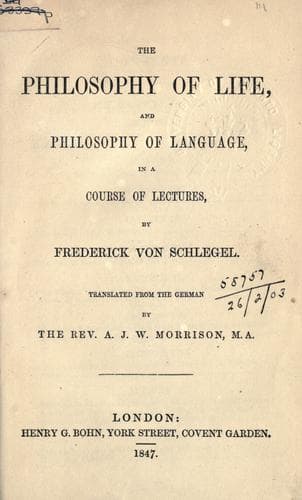
The philosophy of life, and philosophy of language, in a course of lecturesSchlegel, Friedrich von
Philosophy
The philosophy of life, and philosophy of language, in a course of lectures
Schlegel, Friedrich von
Language and languages -- Philosophy; Life; Philosophy
We must, no doubt, admit that there may be very much which the human
intellect can not fathom nor see through. This it would by no means be
difficult to prove. And still more easy were it to show that man’s will
can not always give the law, but must often submit to and recognize a
higher and more universal authority. And as regards the fancy, every one
will be ready--not to say forward--to make a somewhat similar admission.
The faculty of imagination, sensuous and material in its origin and in
its operation, and always remaining in the highest degree subjective, is
liable to innumerable illusions, to which we ascribe no value, or,
rather, which we carefully endeavor to dispel from our minds, whenever
we attempt to penetrate into the inmost essence of the highest truth
which it is the object of faith to embrace. That, moreover, the reason,
no less than the fancy, has its peculiar--one might almost say, its
innate--optical delusions, must be but too well known to every one who
has made the slightest progress in the art of logic, and advanced beyond
the mere elements of a philosophical examination of this faculty.
All this, however, is only a negative nature. The mere recognition and
acknowledgment of the fact that we can and ought to restrain our reason
and reserve our judgment whenever a higher act of faith comes into
question--or, in other words, that in such a case the absolute reason,
with its logical processes and laws of thought, is not alone qualified
to decide, but meets with limits which it is unable to surmount--such
concessions do not lead to any positive result. They do but establish
the possibility of a faith which may transcend and is not confined
within these bounds. While, however, they lead to the inference that
such a faith is thoroughly conceivable, and that while it transcends the
reason is, nevertheless, rational, and capable of being brought into
perfect unison with the sound reason, they do not by any means establish
at once its reality. All this is rather the preparatory step to
believing, and not the true living faith itself.
A true living faith (and we are here speaking of the function of
believing, rather than of the particular details of a positive creed),
is nothing else than the reception into the soul of the truth given unto
us by God. And inasmuch as the soul is in its origin loving, and,
indeed, the very faculty of love, a true living faith can not be
thought of or exist without this accompaniment of love, which is even
its distinctive characteristic.
Public-domain text, read in full here on John Shaqi.
Reviews
Reviews
No reviews yet
Be the first to share your thoughts on this work.
Elsewhere in the archive
Join the Discussion
Join the discussion
Sign in to leave a comment or review.
Sign InorCreate an account