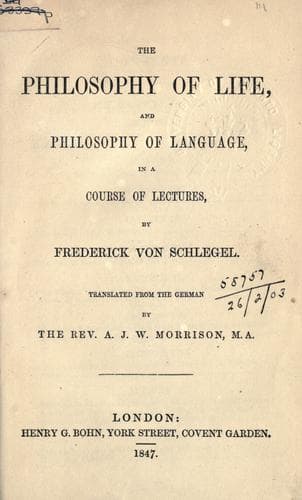
The philosophy of life, and philosophy of language, in a course of lecturesSchlegel, Friedrich von
Philosophy
The philosophy of life, and philosophy of language, in a course of lectures
Schlegel, Friedrich von
Language and languages -- Philosophy; Life; Philosophy
Now there is nothing, however hidden--nothing, however profound--into
which this sensuous principle of knowledge, which investigates all that
is earthly, natural or human, and historical, may not attempt at least
to penetrate. Only the inquiring senses must not quit their true center.
In other words, they ought not to make a hostile attack on the center of
the consciousness, which is even the believing soul. They must not, by
breaking through it, or passing by it, attempt violently and unduly to
ascend to the highest. For in such a case, attempting to create a
supreme and highest object of their own, raising it on their own soil,
and drawing its materials from their own sources, they will produce
nothing but absolutely false and mere nature-gods, or else some
historical phantoms, or idols of national recollections and patriotic
enthusiasm, such as were enshrined in the heathen worship of antiquity.
For even, without material images and altars, such an idolatry may be
revived in a scientific form, similar to what we have witnessed, or, if
we look around us, may still witness, with our own eyes. And as little
can the free spirit of supreme knowledge look down from its own height
on this center of the soul, and pay no regard either to faith or love.
In the depths of sensuous observation, amid all the rich treasures of
physical and historical science, it can not move as sovereign without
being first invested with the luminous garment of pure faith and love.
Otherwise it only hastens from one error to another to fall from the
first abyss into a second and still deeper one.
The pure and living faith of a loving soul abiding permanently in God,
is properly the center of the human consciousness--the natural passage
of life for the senses as they ascend into the heights, and for the mind
or spirit as it penetrates into the depths. It is the connecting mean
which not only reconciles and adjusts, joins and combines the two, but
also restores them to harmonious unity.
In the preceding Lecture I considered the notion of the truth in which
the supreme science and the divine faith coincide, and are at unison in
reference to their subject-matter--consequently, as the right notion of
Him who is truth itself. Viewing it thus from its objective side
principally, I designated it the sum and source of all truth. We have
now, in the progress of our speculations, met again with this notion in
its subjective aspect. It is chiefly in regard to its form that it is at
present to engage our attention. We have, in short, to answer the
question how the consciousness must organically be formed and fashioned,
and divided, but still harmonized in all its parts, so that in thought
and knowledge, in faith, love, and science, in investigating and in
learning, it may be well-grounded and find a stable resting-point, and
be no longer distracted by dissension and doubt.
Public-domain text, read in full here on John Shaqi.
Reviews
Reviews
No reviews yet
Be the first to share your thoughts on this work.
Elsewhere in the archive
Join the Discussion
Join the discussion
Sign in to leave a comment or review.
Sign InorCreate an account