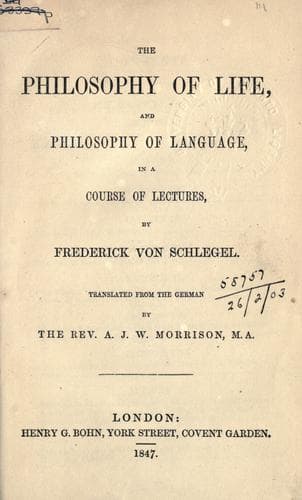
The philosophy of life, and philosophy of language, in a course of lecturesSchlegel, Friedrich von
Philosophy
The philosophy of life, and philosophy of language, in a course of lectures
Schlegel, Friedrich von
Language and languages -- Philosophy; Life; Philosophy
Now the more the living faith becomes love the more does it, through the
immediate feeling and personal experience of life, attain to the
certainty of science. For whatever we experience in our own selves, or
whatever our own life brings as acquainted with, whatever we are
immediately sensible of, and feel that we also know and are certain of
it, that at least is a matter on which we are not likely to be led
astray by the seeming dialectical proofs of the opposite, or by all
skeptical attacks, or objections to the effect that such an immediate
sensation and knowledge of a higher object is impossible. Although we
are incapable of refuting them, we are, nevertheless, unmoved by the
doubts which are raised even against the possibility of our own life and
existence. We let them pass by and still live on in the world until, in
some unlooked-for moment, and some unhoped-for way, the true solution,
and the answer to these cavils which call in question the reality both
of man’s inner life and his personal experience, spontaneously suggest
themselves. And in the same way that the highest science, so soon as it
discerns and understands its own nature, also becomes conscious of
faith, and of its own dependence on faith, and being supported,
completed, and perfected thereby, comes into immediate and living
contact with it, so, on the other hand, the higher faith in the divine,
the more vivid and the more earnest it is in love, becomes a more
immediate conviction, and a science founded on the personal experience
of life.
Faith in the soul, as the center of man’s entire consciousness, may be
likened to the outspread canopy of the blue heavens, according to that
olden notion of it as a firmament, which perhaps in its figurative
investiture still contains much that is strikingly true. According to
this old but beautiful conception, the firmament was a definite limit
that divides the heaven from the earth. Above it the free ether of light
diffuses itself and stretches into the wide regions of illimitable
space; while in the lower sphere, inclosed by the firmament, the wind of
life [_Lebenswind_] now plays with refreshing motion, now descends to
the earth in quickening dews or fertilizing showers, or draws out of the
ground and to the light the hidden springs of life and mighty streams.
Faith, therefore, is, as it were, the heavenly firmament in the
consciousness that divides the streams of spiritual life and of external
and internal science that are above it, from those that are under it. If
this boundary be taken away, or violently broken through, the light and
the darkness are no longer held apart, but mingle together in one
confused and orderless mass. The true light grows darker and gradually
becomes extinct, while the darkness begins to shine with a false glare
and the glimmering twilight of pernicious delusion. The old chaos breaks
in again upon the human mind, and it becomes anew what it formerly was,
“without form and void.”
Public-domain text, read in full here on John Shaqi.
Reviews
Reviews
No reviews yet
Be the first to share your thoughts on this work.
Elsewhere in the archive
Join the Discussion
Join the discussion
Sign in to leave a comment or review.
Sign InorCreate an account