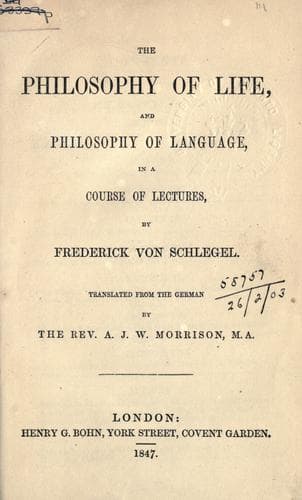
The philosophy of life, and philosophy of language, in a course of lecturesSchlegel, Friedrich von
Philosophy
The philosophy of life, and philosophy of language, in a course of lectures
Schlegel, Friedrich von
Language and languages -- Philosophy; Life; Philosophy
Reason and fancy, therefore--those two faculties of half truth, if it be
allowable so to speak--whenever, instead of seeking to escape from
dissension by reverting to a higher center of unity, they stand
isolated, and attempt each by itself to reign supreme, are the real
source and actual seat of all error. Now, one species of error to which
man has been most prone ever since his soul was rent asunder and lost
its unity, is the subjective shape which he gives to material phenomena.
For that fancy, even when most comprehensive, purest, and best,
invariably remains more or less subjective, is a fact which no man will
either wish or attempt to deny, any more than that the imagination takes
its beginning from the sensuous impressions of the material world. And
this subjectivity of the fancy may, I think, be taken for granted, even
without any reference to and without discussing the question of the
possibility of demoniacal influences.
Now, this subjective shaping of material phenomena forms the foundation
of all mythology; it is the general explanation of all the facts of
heathenism. It is, of course, implied in the very principle of its
explanation, that manifold and various shapes or forms and developments
are both conceivable and possible. And, in actual fact, it exhibits the
greatest diversity, from the rude objects of the grossest Fetischism up
to the exquisite creations of a refined and artistic mythology. In its
actual manifestations, however, and in its effects on practical life,
the latter still retains its affinity with the former; at least, it
rests on the same foundation of a poetical religion--some view of the
universe embodied in a real shape--in short, the deification of nature.
We have here taken the olden heathenism in a very simple light, and
quite generally as a materialism assuming a poetic form and expression,
but one, at the same time, in which, as soon as we pierce through its
poetical investiture, we discern many points of contact with Pantheism.
When, however, pursuing a searching historical inquiry into the heathen
modes of conception, we enter thoroughly and deeply into its details, we
meet therein with so many magical rites and usages, that, in spite of
any previous inclination to the contrary, we feel indisposed to deny the
possibility of a demoniacally-affected imagination having, in some
degree, influenced the character of heathenism. And, indeed, even in a
philosophical point of view, there does not exist any sufficient reason
for such a denial. This, however, as we formerly said, is a matter which
needs not to be taken into consideration at present.
Public-domain text, read in full here on John Shaqi.
Reviews
Reviews
No reviews yet
Be the first to share your thoughts on this work.
Elsewhere in the archive
Join the Discussion
Join the discussion
Sign in to leave a comment or review.
Sign InorCreate an account