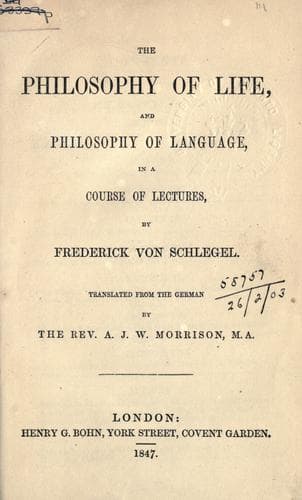
The philosophy of life, and philosophy of language, in a course of lecturesSchlegel, Friedrich von
Philosophy
The philosophy of life, and philosophy of language, in a course of lectures
Schlegel, Friedrich von
Language and languages -- Philosophy; Life; Philosophy
When, however, the triple consciousness preserves its beautiful order
and harmony, then the spirit, as the heavenly height above, the sensible
nature as the deep below, and the soul as the firmament between them,
are indeed divided, but not separated or hostilely opposed to each
other. On the contrary, the height as well as the deep, and the whole
circle of spiritual existence, are organically combined and united
together in this center of faith in the soul. Now this original
constitution of the mind being preserved, the further development and
progress of knowledge and truth may be regarded as the second step of
internal creation, wherein the light begins to shine more and more on
the mind and on science. The first clear insight, on the other hand, and
internal perception that the highest science and the divine faith are
not essentially distinct, but are fundamentally identical, must be
considered as the earliest entrance of the spirit of truth into the
heart of man.
Such is the right notion of faith, and of a mind wherein faith and
science are organically united and harmoniously concordant. But in order
to afford freedom of choice between faith and infidelity, it is
necessary to contrast this living image with the complete picture of a
mind involved in doubt, distraction, unbelief, and error. For all the
motives that can influence a decision must be furnished by a simple
comparison of the two, which, indeed, if made honestly and completely,
furnishes of itself the solution of the problem.
Now I have already more than once called your attention to the tendency
to discord, and to the disposing causes to error which subsist in the
natural constitution of the human mind with its four poles or members.
In particular I directed your notice to the fact that reason and fancy,
such as they now are in their present state of mutual alienation and of
hostile opposition to each other, can not be regarded as original
faculties of the human consciousness. Originally they were both in
unison in the thinking and loving soul so long as living and working in
faith and truth, it was on that account confirmed by the divine Spirit,
and preserved by union with Him. But when it had once lost this center
of unity, and, its light being obscured, it had become a prey to
dissension, it immediately fell asunder into these two halves or
faculties of thought. On the one hand stood the reason--as a mere organ
of reflection--one, _i.e._, which, in lifeless abstraction, thinks over
the objects previously presented to it, or as a mere directive faculty
of thought, without any originative powers of its own; while, on the
other, the fancy presented itself with a blindly-productive energy in
thought and invention, as a wild, but, nevertheless, living sense and
instinct of nature.
Public-domain text, read in full here on John Shaqi.
Reviews
Reviews
No reviews yet
Be the first to share your thoughts on this work.
Elsewhere in the archive
Join the Discussion
Join the discussion
Sign in to leave a comment or review.
Sign InorCreate an account