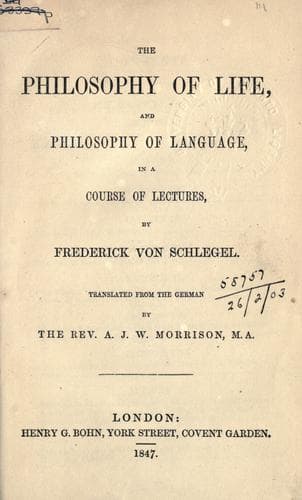
The philosophy of life, and philosophy of language, in a course of lecturesSchlegel, Friedrich von
Philosophy
The philosophy of life, and philosophy of language, in a course of lectures
Schlegel, Friedrich von
Language and languages -- Philosophy; Life; Philosophy
As to the understanding--in one of the earliest of these Lectures, we
mentioned abstract thought as its peculiar form of error. It is
unquestionable that the understanding may lose itself in mere abstract
and dead thinking, so as, amid its mass of purely abstract conceptions,
to forget entirely all truly pregnant and vital cogitation. Such as
understanding, there can be no doubt, must either be defective in its
organization, or imperfectly and falsely developed; and so it goes on
deceiving itself and propagating error among others. Correctly speaking,
however, this abstract thinking does not belong to the understanding,
so much as to the reason, which is even the faculty of abstraction. And
indeed, apart from its great and manifold abuses, the latter, in its
right place and within its assigned limits, forms nothing less than a
natural requirement and an essential function of the human mind. As for
the understanding, it is based on intellection; consequently it supposes
that in this intellectual act the object is vividly seen through and
thoroughly penetrated by the mind. And this object may be either an
external one, taken from nature or actual life, or internal--a mere
thought or conception, and the word or name designating it. In the
latter case, the mental act of penetration is directed to ascertaining
the true and original sense of an idea, or the import of the notion, or
of the term by which it is designated. An understanding which has lost
itself among abstract ideas must, in such purely abstract thinking,
become eventually entirely extinct. Wholly, however, without life and
spirit, the understanding, according to its peculiar character, can
never be; it is therefore its total absence, or a very defective
condition of it, rather than its death, that is marked out and indicated
by such a state.
But if we wish to determine the particular fault or error that is
peculiar to any one faculty of the human consciousness, it is evident
that we must not seek for it in any defective state or imperfect
development; but, on the contrary, in the highest and fullest energy.
But now an extremely ingenious, clear, and vivid intellect may be
combined with what I have lately termed an evil genius--the false power
of genius. In such a combination, we have the true state of a perverted
understanding, or of that aberration which is peculiar to it, and for
which the term of a sophistical intellect seems the tersest and most
appropriate designation. And this sophistical understanding is ever the
working organ and instrument for the building and construction of all
false systems, and to which sooner or later the latter are all obliged
to have recourse.
Public-domain text, read in full here on John Shaqi.
Reviews
Reviews
No reviews yet
Be the first to share your thoughts on this work.
Elsewhere in the archive
Join the Discussion
Join the discussion
Sign in to leave a comment or review.
Sign InorCreate an account