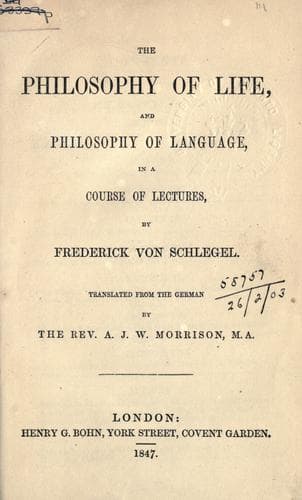
The philosophy of life, and philosophy of language, in a course of lecturesSchlegel, Friedrich von
Philosophy
The philosophy of life, and philosophy of language, in a course of lectures
Schlegel, Friedrich von
Language and languages -- Philosophy; Life; Philosophy
With regard, then, to the co-operation of the sophistical understanding
in the formation of philosophical error, and its share and influence on
the spirit and the matter of any system of untruth, it furnishes an
opposition to the idealistic confusion which the absolute will produces
by its predominant idea of the unconditional. Here we have rather a
predominating tendency to a realistic view of the world, according to
the principle it adopts of the universal insignificance of all things,
not merely in reference to morals or practical life, and in the domain
of history, but also in nature and the whole creation. And with this
view is associated a skeptical contempt for all who dare to think
otherwise--all ordinary minds who can not rise to the height where the
consciousness of knowing and believing nothing sits enthroned. This
tendency, therefore, and this error of the sophistical understanding, is
most immediately related to, and associated with, the dialectical
confusion of the reason with its endless disputations. But as the
absolute volition and pursuit of the unconditional can not well be
thought of entirely apart from a certain perversion of the intellectual
powers, so the operation of the sophistical understanding is impossible,
without a certain admixture of an evil will and an intentional
determination to oppose the truth.
But notwithstanding this intrinsic connection between these two
intellectual faults, yet in their outward manifestation, and in actual
life, they often stand wide apart from each other. The true notion of a
sophistical intellect will perhaps be best illustrated in a few words by
recalling to your recollection the most celebrated writer of the
eighteenth century, who exercised so great an influence not only on the
minds of his countryman, but on the whole spirit of the age.[50] If,
again, it were necessary to employ instances in order to give you a
clear idea of the philosophical pursuit of the absolute, examples enough
might be found among the German schools and philosophers of recent
times. But to revert to the sophistical intellect: rarely has it been,
and rarely will it be, found manifesting itself in such fullness as it
did in this anti-Christian and worldly writer, who indeed worshiped the
age which worshiped him, but mocked and scoffed at all besides.
Now as to these two opposite systems of error and unbelief--rationalism,
viz., and a false idolatrous system of nature--in their inmost essence
they are both equally false and pernicious. In this respect there is
nothing to choose between them; they are alike utterly abominable. Even
in the judgment of theology, pantheism, as the one extreme of error on
the side of nature, can scarcely appear less false and abominable than
atheism as the other idealistic extreme. Both must be placed on the same
line; for the one no less than the other is a full and perfect refusal
to recognize the one Eternal Truth and the Living God.
Public-domain text, read in full here on John Shaqi.
Reviews
Reviews
No reviews yet
Be the first to share your thoughts on this work.
Elsewhere in the archive
Join the Discussion
Join the discussion
Sign in to leave a comment or review.
Sign InorCreate an account