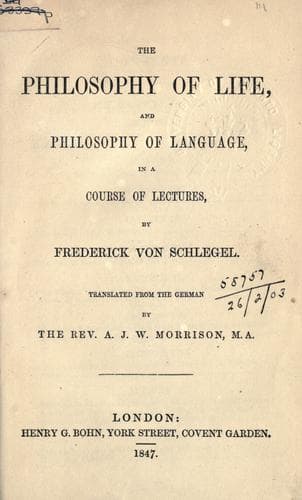
The philosophy of life, and philosophy of language, in a course of lecturesSchlegel, Friedrich von
Philosophy
The philosophy of life, and philosophy of language, in a course of lectures
Schlegel, Friedrich von
Language and languages -- Philosophy; Life; Philosophy
The union of profound knowledge with divine faith, and the recognition
and perception of their unity, is the mind’s first step within the
domain of truth and of the consciousness of it; or, rather, the first
step in that gradation by which the mind and consciousness advance
toward verity; and it is even the fundamental principle of truth itself
that constitutes this beginning. The judgment which discriminates and
decides between a simple universal belief in God, and the connection of
such a faith with all natural and sublimely true philosophy on the one
hand, and unbelief, false science, and the various systems of error on
the other, forms the second term or step in the gradual progress of
truth and the spirit of truth in the human consciousness, whether of
individuals, or of the whole human race, or of any particular period of
its development. These two subjects have already occupied our attention
in the two preceding Lectures. The third point which the mind must
attain to as the spirit of truth is more fully expanded, both in the
consciousness and in science, is the profitable application thereof to
actual life, or its real manifestation, and the practical carrying out
of its principles. For it is by this alone that the divine and
fundamental principle of truth, and that important faculty of judgment
which separates and distinguishes truth and true science from ignorance
and error, are realized, and attain to their full end and perfection.
The consideration of this subject will form the basis of the present and
all the following Lectures.
Before, however, I enter upon this new topic, or attempt to solve this
third problem of the actual application of science to life and of its
profitable combination therewith, I would wish to add here a few
historical remarks on the subject-matter of our last discussions, which,
while they serve to complete and to illustrate it, will at the same time
furnish a natural and easy transition to our present speculations. The
struggle and the alternate triumph of belief and unbelief, as they
gained in turn the ascendency over the minds of men, and gave the
dominant tone to different ages, or, rather, the contest of truth and
true science with the different systems of error in the several periods
of the development of mankind and of the history of the human intellect,
is at all times a subject of the highest interest for philosophical
observation. In historical applications like the present, it invariably
proves pre-eminently useful and instructive. I shall, however, confine
myself to a few examples, and select such as are most immediately
connected with our subject, or seem likely to lead to the most important
results.
Public-domain text, read in full here on John Shaqi.
Reviews
Reviews
No reviews yet
Be the first to share your thoughts on this work.
Elsewhere in the archive
Join the Discussion
Join the discussion
Sign in to leave a comment or review.
Sign InorCreate an account