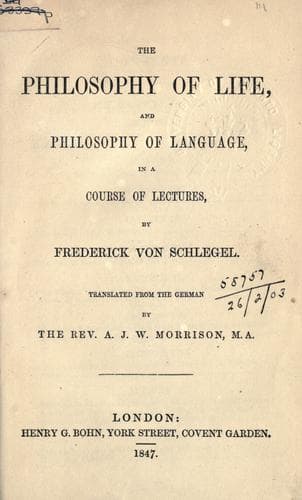
The philosophy of life, and philosophy of language, in a course of lecturesSchlegel, Friedrich von
Philosophy
The philosophy of life, and philosophy of language, in a course of lectures
Schlegel, Friedrich von
Language and languages -- Philosophy; Life; Philosophy
Now, as the beginning and the end often bear a wonderful resemblance to
each other, it is not improbable that the first sect was of the same
kind and nature as it has been predicted that the final heresy will be.
A mere dead unbelief and purely negative atheism, it is true, can as
little have prevailed in those times as a symbolically degraded and
immorally materializing heathenism. For it was only after the higher
magical powers were withdrawn from man, that the fancy became in this
sense, and to such an extreme degree, symbolical and figurative. Or,
perhaps, we may more correctly say, that of all high endowments now lost
forever, a purely figurative fancy was all that remained; whereupon, in
opposition to it, the other erroneous extreme of abstract thought
gradually attained to a greater and undue development. And we may with
good reason assume, that with this fearful catastrophe the very
consciousness of man was essentially altered and changed. Of the wild
and lawless state of the generations before the Flood, we can not,
perhaps, form a juster conception than by regarding it as an open
rebellion and organized revolt of man against his Maker and benefactor,
a complete and visible supremacy of the evil principle and the wicked
spirits on earth, and an intimate union between man and the devil. It
must have resembled the description which we meet with in some old books
of the future reign of antichrist. Such a state of things may justly be
denominated atheism. But, however this may be, and whatever conception
we may form, and whatever historical shape we may give to particulars in
this domain (where, after all, we can not get beyond conjecture and
presumptions, or, it may be, hypothetical history, based on
probabilities), one general point is incontestable. Truly noble, in
those primeval times of a pure natural faith, must have been the
intellectual powers and development of the first ancestors of the world
and those great progenitors of the human race, and fearful, in the same
degree, must have been the fall and corruption which followed the abuse
of those high privileges. For man’s mental powers, still subsisting in
the plenitude of their productive energy, and his lordship over nature
being undisturbed, his corruption must have generated the wildest and
most monstrous excesses. Consequently, amid the universal reign of evil
and wickedness, the only course that remained was the total destruction
of the existing generation, and the complete renovation, or, rather, a
new commencement of mankind.
Public-domain text, read in full here on John Shaqi.
Reviews
Reviews
No reviews yet
Be the first to share your thoughts on this work.
Elsewhere in the archive
Join the Discussion
Join the discussion
Sign in to leave a comment or review.
Sign InorCreate an account