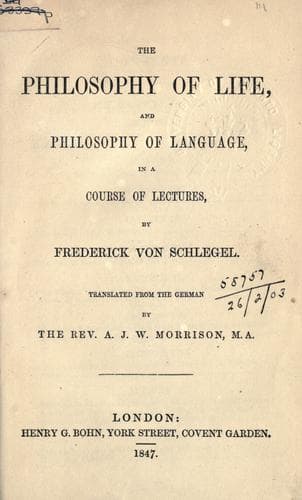
The philosophy of life, and philosophy of language, in a course of lecturesSchlegel, Friedrich von
Philosophy
The philosophy of life, and philosophy of language, in a course of lectures
Schlegel, Friedrich von
Language and languages -- Philosophy; Life; Philosophy
For though the oldest philosophers of the Ionian school held water, or
air, or fire, to be the ground and principle of all things, and built on
such hypotheses their whole theory of nature, nevertheless we should, in
all probability, greatly err, were we, on that account, to charge them
with or to suspect them of materialism. They understood these elements,
not in the ordinary, but in a spiritual and living sense, as the
elements of universal life, and, at the same time, did not fail to
acknowledge a higher spirit operating in and above nature, and God’s
all-disposing intelligence. Of Heraclitus, who made fire the essential
ground and first principle of all things, we know, with historical
certainty, that, notwithstanding, his philosophy and view of the
universe was, in the highest degree, ideal and spiritual. And the same
is true also of Anaxagoras, the teacher of Socrates. Much, too, that
would do great credit to the general spirit of thought and science of
that period, might be adduced from the venerable founder of the valuable
art of medicine, and also from his school, were the present the
appropriate place. The simple fact, too, that Socrates proceeded from
out of this Ionian school, would alone dispose me to form a favorable
opinion of it in its earliest state; and it is greatly to be regretted
that our information concerning the oldest of these great thinkers is so
scanty, and its details so uncertain and so little to be depended on,
that it is impossible to form any settled and definite judgment on the
matter.
When, however, we proceed to examine the religious spirit and value of
Grecian philosophy in general, or any of its special branches, schools,
and epochs, we must adopt as the fundamental rule of our judgment the
universal dogmas of man’s pure and uncorrupted feelings or judgment.
Taking for our standard the natural belief in a living and personal God,
and in an everlasting and all-ruling spirit, in the immortality of the
soul, and in the freedom of the will, together with the immutable
principles and ideas of justice, honor, morality, and virtue, we must,
in this case, carefully exclude all the special doctrines of a positive
faith. We must not look for or require, in so early an age, that which
the further development of later periods brought to light. Far be it
from us to wonder at, or to urge it as a reproach against Pythagoras or
Plato, if among their doctrines we meet with ideas, which, strictly
understood, are not perfectly consistent with Christianity. Rather is it
a matter for surprise and congratulation that they knew and were aware
of, had anticipated and taught, so much that a later date first placed
in a fuller light, and made the common property of all men. This, at
least, was the opinion and conclusion on this subject entertained in the
first century by the greatest and best-informed of the fathers of
Christian doctrine and science.
Public-domain text, read in full here on John Shaqi.
Reviews
Reviews
No reviews yet
Be the first to share your thoughts on this work.
Elsewhere in the archive
Join the Discussion
Join the discussion
Sign in to leave a comment or review.
Sign InorCreate an account