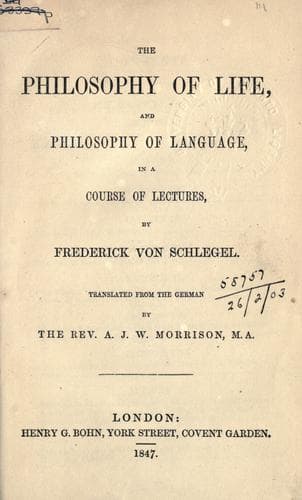
The philosophy of life, and philosophy of language, in a course of lecturesSchlegel, Friedrich von
Philosophy
The philosophy of life, and philosophy of language, in a course of lectures
Schlegel, Friedrich von
Language and languages -- Philosophy; Life; Philosophy
This highly religious tendency and perception which we recognize in
Pythagoras, for instance, or in Plato--this anticipation by science of
the ideas of Christianity, of principles which, with this exception,
belong to the Christian era of the world’s history, could not have been
without God. We must, in short, recognize therein a higher providence.
We may accordingly justly regard Grecian philosophy, in its better
spirit and elements, as forming on its part a preparation for the
Gospel, and a scientific introduction to Christianity, of a special and
peculiar kind.
Now, among those whose observations, and sciences, and endeavors were
throughout directed Godward, the Pythagoreans stand highest and
foremost. We have already alluded to the fact, that in physical science
they were acquainted with the best and the most important of all that
our history of discoveries, within the last three centuries, is so proud
of. Here and there, perhaps, their knowledge even outran our own, and in
all probability they were not without some insight into those mysteries
of creation, about which our philosophy of nature has within the last
half century excited so much wonder and admiration. It is also probable,
we observed, that by their theory of numbers we are not to understand
the ordinary formulæ of mathematics, nor the usual arbitrary play with
them in which science so often indulges, but rather the development of
the intrinsic and divine law of nature and of life according to its
everlasting structure and immutable foundations, or according to the
vicissitudes of its critical times and seasons. But here it may be
asked--whence had they all this? how, without the telescope, and with,
at best, a very defective system of mathematics, and an imperfect art of
calculation, did they attain to a knowledge of the true astronomical
system of the universe? To start the hypothesis, that they learned and
borrowed it all from the Egyptians, would only be to remove the question
a step farther back, and not really to answer it. But even if we were
to admit the fact, such an assumption would only, as regards the
essential question with respect to the Pythagoreans and the origin of
their science, increase their merits and their glory. For in the same
way as we observed on an earlier occasion, with reference to Moses and
the Hebrews, it must have been by the exercise of a rare wisdom, that
while they selected all that was best and most valuable in Egyptian
science, they rejected so much that was pernicious, and laid aside so
much that was likely to lead them astray, and even the impious magical
superstitions that were to be found there.
Public-domain text, read in full here on John Shaqi.
Reviews
Reviews
No reviews yet
Be the first to share your thoughts on this work.
Elsewhere in the archive
Join the Discussion
Join the discussion
Sign in to leave a comment or review.
Sign InorCreate an account