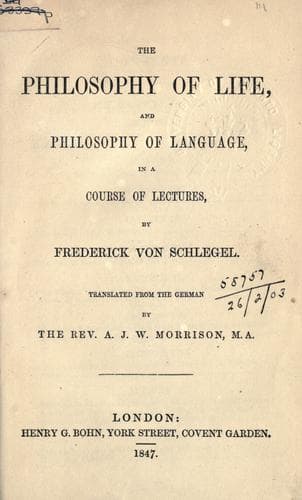
The philosophy of life, and philosophy of language, in a course of lecturesSchlegel, Friedrich von
Philosophy
The philosophy of life, and philosophy of language, in a course of lectures
Schlegel, Friedrich von
Language and languages -- Philosophy; Life; Philosophy
In the little intercourse subsisting, at this period, between distant
nations and lands, and the almost total separation of the East from the
West, it was only through the Arabic versions, or Latin translations
molded again upon these, that any knowledge of this philosophy could be
drawn. This must have led, it is obvious, to a wide deviation from the
true sense and critical spirit of the author. Its original aim must have
been generally missed. For, however highly we may be disposed to
estimate the intellectual merits of the Arabians, as writers of their
native history, or in poetry, or in any other science, they are
notoriously deficient in the true critical spirit. Their total and
universal want, in this respect, is especially evident when they are
compared with the Greeks, among whom this critical acuteness, whether
false or true, sprung up and reached its greatest height.
Strange, no doubt, and singular is it at first sight, to view this old
master of philosophical thought and science, who, on the whole, is so
perfectly heathen, suddenly received among the medieval theologians, and
taking, as it were, his seat, and giving his voice among them. Still, if
men of great mental powers and authority sought to make themselves
masters of the whole matter--both of the much-disputed works of this
writer, this Aristotle, so strangely disguised in his new motley dress
of Arabic Latin, and also of the voluminous labors bestowed upon
him--we must look upon this procedure as analogous to that of the
thoughtful physician, who, in the midst of a wide-spread pestilence and
inevitable contagion, prefers to inoculate it himself, in order the more
safely to treat and to cure it. In short, as the case really stands, we
must look on these illustrious men in two distinct lights. On the one
hand we must see in them the Church’s venerable teachers, and the
sagacious and discriminating theologians of the day; on the other, the
scholastic interpreters of Aristotle, who had now become a necessary
evil for the Christian middle ages.
Public-domain text, read in full here on John Shaqi.
Reviews
Reviews
No reviews yet
Be the first to share your thoughts on this work.
Elsewhere in the archive
Join the Discussion
Join the discussion
Sign in to leave a comment or review.
Sign InorCreate an account