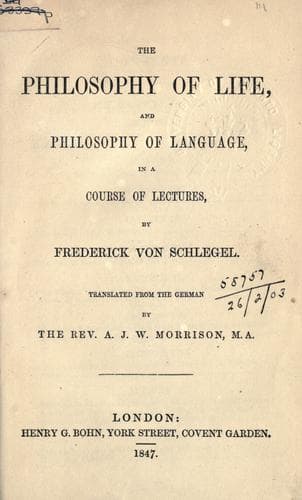
The philosophy of life, and philosophy of language, in a course of lecturesSchlegel, Friedrich von
Philosophy
The philosophy of life, and philosophy of language, in a course of lectures
Schlegel, Friedrich von
Language and languages -- Philosophy; Life; Philosophy
This, however, and whatever else was the matter and object of such
subtile disputes, was too soon forgotten. In these scholastic contests,
after the fashion of the day, the combatants, horse and man, were armed
_cap-a-piè_, incased and disguised in logical coats of mail, composed of
countless rings of thought and chains of ideas. With this heavy panoply,
the great object was to heave their antagonist out of the saddle. Often
they recoiled from the shock without advantage on either side--so
equally matched were they in their good lances and the weight of their
armor--and often they swerved from the charge. Mostly, however, both of
the philosophical knights found themselves, at the end of the strife, at
their old station in the lists, or driven back, perhaps, to their
original entry. This scholastic philosophy, in the form it now took, of
a highly elaborate art of logical tourney in the philosophical schools,
was, undoubtedly, an abiding evil in the age that immediately followed,
and furnished an important element to the party disputes of later, and
to the rationalism of these latest times.
The overthrow of the Grecian empire and the discovery of the new world,
suddenly and at once introduced into Western Europe vast and varied
treasures of historical, physical, and philosophical knowledge. In this
brilliant epoch of the fifteenth century, a new world of thought was, as
it were, laid open. A new era of science would have been founded, and a
veritable reformation of the whole Christian life must have ensued, had
not the moral corruption and the political disorders of the period been
gross beyond description. But for all this, how much is there to admire
in the Platonic writers of the fifteenth century, among whom Germany,
after Italy, produced the most famous and the greatest number? When we
take up, even now, any one of their works, and contemplate therein
their comprehensive liberal pursuit of science, their mild, antique
spirit, their noble form, and their quick recognition of the beautiful,
we can not turn from them without regret to that new state of barbarism
into which, during the sixteenth and part also of the seventeenth
century, science was plunged by the rampant spirit of party and
controversy.
Public-domain text, read in full here on John Shaqi.
Reviews
Reviews
No reviews yet
Be the first to share your thoughts on this work.
Elsewhere in the archive
Join the Discussion
Join the discussion
Sign in to leave a comment or review.
Sign InorCreate an account