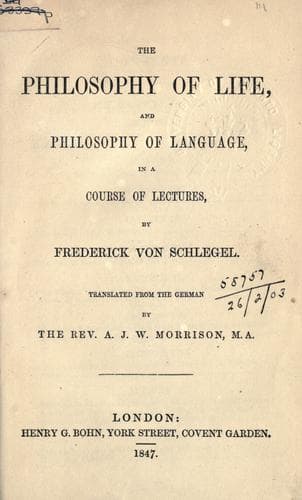
The philosophy of life, and philosophy of language, in a course of lecturesSchlegel, Friedrich von
Philosophy
The philosophy of life, and philosophy of language, in a course of lectures
Schlegel, Friedrich von
Language and languages -- Philosophy; Life; Philosophy
At last, however, peace and quiet returned again to Christian lands and
states, and slowly, and by degrees, to the minds also of men. And now
was it, in the eighteenth century, and especially toward the middle of
it, that out of this apparent and superficial peace, a new science, or a
new light, or at least a new diffusion of it, seemed ready to arise.
Simply regarded in a scientific point of view, this philosophical
endeavor of the eighteenth century, and the most memorable of the
systems to which it gave rise, occupied our attention in the very
opening of these Lectures. Here the immediate object of our
consideration is not this new science itself, whether true or false, but
rather the influence on the age, and on life in general, of this modern
mode of thinking, as generally diffused and prevalent.
Much, undoubtedly, has been discovered or newly learned in the natural
sciences and in the domain of history; many too have been the bold
ventures, at least, and novel essays in philosophy. This new wisdom,
moreover, was taught and disseminated far more universally than ever
before had been the case; while even the agreeable feeling produced by
the moderation of the intellectual spirit now prevalent, greatly
promoted its wide and rapid diffusion. But at a later period this
enlightenment, so rapidly and so widely diffused, which, moreover, was
taken only in a negative sense, was soon recognized to be unsatisfactory
and superficial, while also the theory of popular liberty and
independence which was grafted thereon, and claimed, or at least wished
to be rational, bore the bitterest and worst of fruits.
In short, to speak most leniently of it, the whole was nothing less than
the undigested scheme of an immature and imperfect knowledge, brought
into the world before its time. Accordingly, its rash and precipitate
course in the last age, whose history is unparalleled in the annals of
the whole world, together with the fearful catastrophe which it has
brought about, opened the eyes of men to the fearful abyss to which such
a precipitate abuse of science had hurried them. And, in consequence,
thinking men of the highest endowments and the richest intellectual
gifts among different nations, have in many ways nobly devoted
themselves to the work of restoration in sentiment, in thought, and in
science.
But on the one hand, the first elements of the former destructive
principle appear to be still existing, even though it be in less obvious
and more pliable and disguised forms. On the other hand again, the
corrected mode of thinking, and the better tone of sentiment and
science, is for the most part confined merely to a more chastened
outward form. Scarcely any where as yet is it carried far enough back,
up to the profoundest sources of spiritual life, up to the primal origin
and veritable foundation of the divine and of the eternally good.
Public-domain text, read in full here on John Shaqi.
Reviews
Reviews
No reviews yet
Be the first to share your thoughts on this work.
Elsewhere in the archive
Join the Discussion
Join the discussion
Sign in to leave a comment or review.
Sign InorCreate an account