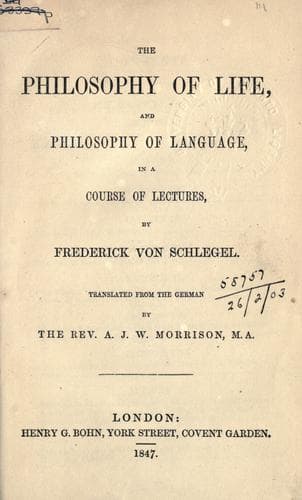
The philosophy of life, and philosophy of language, in a course of lecturesSchlegel, Friedrich von
Philosophy
The philosophy of life, and philosophy of language, in a course of lectures
Schlegel, Friedrich von
Language and languages -- Philosophy; Life; Philosophy
Now, according to this view, that science consists in the mutual
approximation to, and the final attainment of, a perfect unity between
thought and life, there are three degrees of it, according to that
triple gradation and threefold principle which exists in the human
consciousness. The first of these, then, is reflection. And this,
understood in a somewhat profounder acceptation than ordinarily, is an
internal feeling, hearing, or seeing of one’s own thinking. Consequently
it is a perception similar to that of the senses, by means of which the
unseen thought is in some degree projected and introduced into external
reality. But this act of reflection is nothing more than a passive state
of the soul in its internal observation of itself. So long as it remains
confined to this narrow sphere, it perpetually revolves in the same
orbit, and, properly speaking, produces no ulterior results of a
knowledge fruitful and applicable to actual and outward life.
The second degree or moment of science is abstraction, by virtue of
which, from the complete sum of all the criteria and characteristics of
an object, or, rather, of a thought, some one is prominently set forth
as the most essential, and for the sake of communication designated by a
name. For all communication and language is based on this faculty of
abstraction, which is itself an arbitrary act of the free will. But
although by this naming, generalization, and communication, the internal
thought is advanced a step farther into the external world and the
living reality among and with others, still the reality of the thought
is by no means satisfactorily established thereby. For this very liberty
in the choice of name, of combination, and of general classification,
opens a wide field for caprice. This is evident enough from the
countless multitude of terminologies, so needlessly invented and so
rapidly thrown into oblivion, which form so many remote and mutually
unintelligible philosophical dialects, in the ever-repeated attempt to
build methodically the Babel tower of philosophical system. For these
designations of abstract thoughts, even when they are most felicitous,
fail to win the concurrence of others, and do but open a door to endless
dialectical disputation.
Public-domain text, read in full here on John Shaqi.
Reviews
Reviews
No reviews yet
Be the first to share your thoughts on this work.
Elsewhere in the archive
Join the Discussion
Join the discussion
Sign in to leave a comment or review.
Sign InorCreate an account