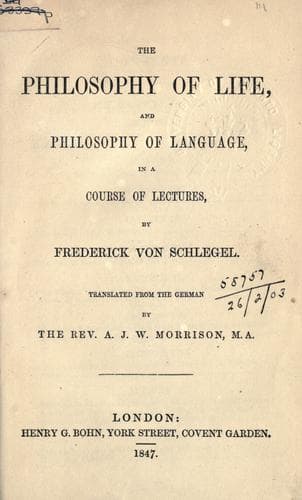
The philosophy of life, and philosophy of language, in a course of lecturesSchlegel, Friedrich von
Philosophy
The philosophy of life, and philosophy of language, in a course of lectures
Schlegel, Friedrich von
Language and languages -- Philosophy; Life; Philosophy
Thus, then, neither reflection, which is eternally revolving within the
narrow orbit of our inward self, nor empty abstraction, though it strays
at pleasure over the spacious realm of the possible, can lead us to the
desired end of perfect certainty or veritable science. It is alone the
practical carrying out into real life of a speculative thought, that can
bring it to the conclusion of perfection of certainty, and to a complete
and true science. Now I should prefer to designate this its highest
grade by the notion and name of _consequence_. But by this term, I must
be understood as meaning not merely a correct logical enchainment of
ideas, but pre-eminently a faithfully-worked-out _consequence_ or
consistency of sentiment and life, _i.e._, a perseverance in good. At
the same time, it must ever be remembered, that the evil principle,
although it often makes a boast of possessing this quality, does so only
in appearance, and never in this true sense. On the contrary, torn to
pieces by conflicting passions in its inmost being, it is really in the
highest degree inconsequent, as acting in direct opposition to its
beginning and origin, which, like all other created beings, it took and
received from God.
Truly consequent or consistent a man can not be except in the truth,
_i.e._, in Him out of whom all truth, and from whom all existence is
derived and flows--in other words, in God. Science, therefore, is an
_applied_ thinking, _i.e._, one that has passed into life, and thereby
become real and certain; and it is only on the road of practice, by its
actual carrying out or _real_ manifestation, that it can attain to its
highest degree, and that the truth of an idea or speculative thought can
be satisfactorily attested.
The ideas, according to the original sense of the term, are even the
self-existing thoughts of a higher life, as distinct both from the
simple facts of the consciousness in the domain of reflection, and from
the arbitrary forms of thought set up by empty abstraction. And though
even here as elsewhere, a false, sickly, or a null and illusory life,
may be substituted for that which is true, still this applies only to
the form of the living idea, as contrasted with the sensuous semblance
or the dead notion. For, that an idea is truly divine, can only be
proved by this quality of consequence--by its divine influence and
effect on life.
Public-domain text, read in full here on John Shaqi.
Reviews
Reviews
No reviews yet
Be the first to share your thoughts on this work.
Elsewhere in the archive
Join the Discussion
Join the discussion
Sign in to leave a comment or review.
Sign InorCreate an account