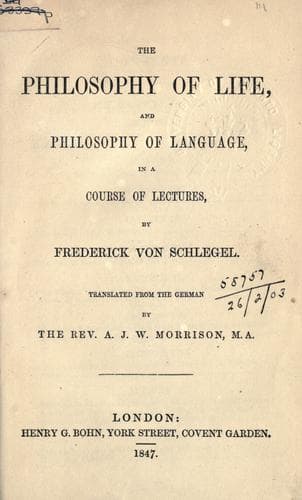
The philosophy of life, and philosophy of language, in a course of lecturesSchlegel, Friedrich von
Philosophy
The philosophy of life, and philosophy of language, in a course of lectures
Schlegel, Friedrich von
Language and languages -- Philosophy; Life; Philosophy
Now, in the form in which this science or discipline has come down to us
from the Greeks, there is much that is rather an accident than a part of
its essence, and whose presence must be accounted for by some special
and local necessity. With no people before or since has rhetoric enjoyed
so commanding an influence as with the Greeks, and with none also has
the sophistic art produced such great and such pernicious effects.
Accordingly, they found it necessary to devote to the analysis of all
its arts, delusions, and tortuous windings, and also to the development
of the dialectical means for their detection and refutation, a
disproportionate degree of attention, which is neither necessary for us
nor practically useful.
The Hindoos, likewise, have from the most ancient times possessed a
scientific system of logic. Indeed it has even been said, that
Aristotle, having received from Alexander the Great some of their
logical treatises, borrowed from them his own system, or, at least,
molded it after them. But from the reasons just adduced, I am disposed
to think that, in all probability, the Hindoo logic was much simpler
than the Grecian, where the simple end of truth, and the great
desideratum of a correct standard thereof, was lost sight of amid an
overminute analysis, and the mazes of an endless subdivision of notions.
In the routine of our school education logic might, perhaps, be made a
highly profitable study if only it were combined with and made to bear
upon the history of the gradual development of human thought, and
especially the theory of language. And then, since thought and speech
are so intimately allied to and dependent on each other, it would be
advisable to go a step farther, and extend our logical studies to the
theory of imagination, symbolical language and its fundamental rules.
In a scientific education, too, a logic of the memory (if we may be
allowed the expression) would in all probability be highly useful. For
an established law and disposition of our thoughts would greatly
facilitate the exercise of memory, and as furnishing rules for the
practice, or generally as an exercise of that faculty, would form an
excellent basis for scientific education. For the conduct of life,
indeed, there is nothing so important or so desirable as a right logic
of the conscience, which should detect all the internal delusions of
egoism and the still more subtile sophistry of selfishness in every
point where the question lies between the righteous truth and a latent
falsehood. And this is intimately connected with, or at least leads
directly to, the notion of the sound reason which requires before all
things a conscientious susceptibility of the truth.
Public-domain text, read in full here on John Shaqi.
Reviews
Reviews
No reviews yet
Be the first to share your thoughts on this work.
Elsewhere in the archive
Join the Discussion
Join the discussion
Sign in to leave a comment or review.
Sign InorCreate an account