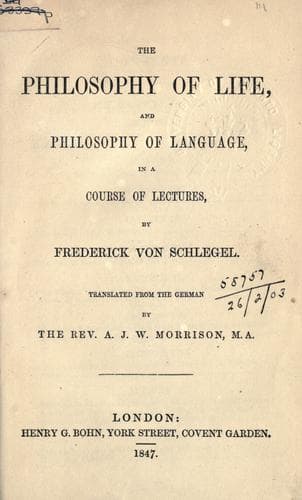
The philosophy of life, and philosophy of language, in a course of lecturesSchlegel, Friedrich von
Philosophy
The philosophy of life, and philosophy of language, in a course of lectures
Schlegel, Friedrich von
Language and languages -- Philosophy; Life; Philosophy
On the other hand, many philosophical thinkers have somewhat erroneously
indicated the intrinsic certainty of philosophical thought by the name
and under the form of an intellectual intuition, and thereby given
occasion to manifold misconceptions. But if in all the fullness of the
conception already advanced of the eternal truth, and of Him who is its
sum and source, we were really able to be sentinent of and to feel the
divine life--to hear and audibly to perceive the eternal Word and
actually to see the holy Light, such a spiritual intuition of God’s
glory and majesty would be far more appropriate for the future than for
the present world. And even though we may and can admit it to be
conceivable, as given from above, still a communication of it would be
impossible, and, consequently, could not be available for the ordinary
purpose of giving a philosophical foundation to any human system. Under
this form, then, of a so-called intellectual intuition, if it be really
such, and not rather a mere form of abstract thought under another and
an assumed name, speculative science would consequently assume the
character of a questionable vision, and a possible mental delusion. For
a full internal satisfaction and certainty--so far at least as these are
attainable by man--even in the case that they are the sign and the proof
that this intuition, or perception of the divine light actually took
place, can only be furnished by that quality of consequence already
described as belonging to every thought and cognition which is founded
in God. And to this character of consequence or consistency, the
condition of agreement with every other idea or revelation already
acknowledged to be divine, belongs naturally as the irrefragable law of
judgment and of life.
That full and correct conception of eternal truth which has been
developed by us in the ninth Lecture as the living _idea_ of the Supreme
Being is unquestionably the fundamental speculative notion and the
internal spiritual basis on which every other higher science, that has
any pretensions to the qualities of permanence and consequence which
belong to right-thinking and to immutable truth, is subsequently
raised, or, in other words, it is the source from which it abidingly
flows. In the three subsequent Lectures, however, the subject has been
mostly scientific, speculative, and metaphysical, though throughout
accompanied with historical illustrations drawn from the development of
the human mind. And here, accordingly, a reference to the science or
discipline of logic is every where supposed.
Public-domain text, read in full here on John Shaqi.
Reviews
Reviews
No reviews yet
Be the first to share your thoughts on this work.
Elsewhere in the archive
Join the Discussion
Join the discussion
Sign in to leave a comment or review.
Sign InorCreate an account