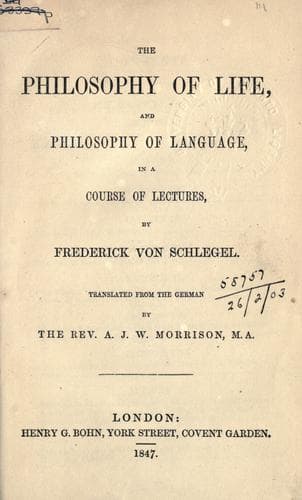
The philosophy of life, and philosophy of language, in a course of lecturesSchlegel, Friedrich von
Philosophy
The philosophy of life, and philosophy of language, in a course of lectures
Schlegel, Friedrich von
Language and languages -- Philosophy; Life; Philosophy
How difficult it generally is for man to express his internal
conceptions, to bring out the indwelling idea and to realize its perfect
external manifestation, is shown, for example, among other instances, by
the fine arts, or the art of the beautiful. For this reason the theory
of the latter, the so-called æsthetics (which, however, might far more
correctly be termed symbolism), forms the natural pendant and
accompaniment to logic, if the latter, instead of being limited, as is
usual, to the mere art of distinguishing the different kinds of notions,
is understood in a far higher sense, and referred to eternal, and,
consequently, divine truth, and to its intrinsic and equally divine
standard. For when the question no longer involves a purely material or
simply subjective verity, but that which is more exalted and heavenly,
then beauty (that, namely, about which art is conversant, and which, far
surpassing all that is merely human, pretends and really ought to be
divine and supernatural) forms the other and symbolical aspect of one
and the same eternal truth. And indeed it is neither separable from it
nor opposed to it, so long as art maintains its high standing and
employs the sensual charm which it requires for the lively expression of
vitality, and its outward manifestation, only as a symbol and for the
sake of that higher significance which she herself lends to it, and does
not seek nor admire it for its own sake, nor sees therein the
fulfillment of its own true end and aim.
But by far the greater number of the productions of art are only
repetitions or copies of some previous realization. And I use this term,
not in its usual depreciatory sense, but rather in one that is
applicable to what are truly artistic productions but still only
successful formations at second-hand. Extremely rare, indeed, are the
original expressions or impressions of an indwelling, unborrowed idea
And even among these very many are nothing more than the first faint
outline and commencement, which only at a subsequent epoch of art, and
after long and repeated essays, attains to complete perfection and a
really successful and veritable outward exhibition of the indwelling
idea. For we must ever consider as an idea that inward object which art
in its external manifestations strives to realize, and which in its
creations ought to stand out, as it were, bodily before us.
Public-domain text, read in full here on John Shaqi.
Reviews
Reviews
No reviews yet
Be the first to share your thoughts on this work.
Elsewhere in the archive
Join the Discussion
Join the discussion
Sign in to leave a comment or review.
Sign InorCreate an account