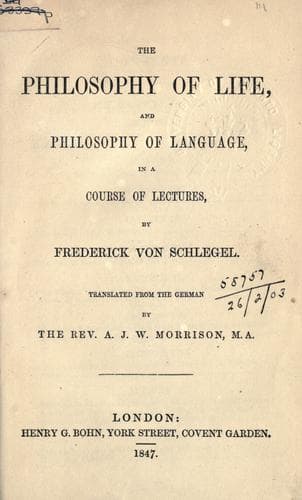
The philosophy of life, and philosophy of language, in a course of lecturesSchlegel, Friedrich von
Philosophy
The philosophy of life, and philosophy of language, in a course of lectures
Schlegel, Friedrich von
Language and languages -- Philosophy; Life; Philosophy
Even in music (as the expression of the emotions of the soul in their
flow and change, and in the struggle with inharmonious discords, till at
last they finally dissolve in harmony) it is not so much the immediate
feeling--for this would be no more artistic than the mere cry of
passion--as rather the idea of it that the artist has in his mind, and
that forms the subject of his representations. The musician strives to
represent the whole idea--the beautiful and the marvelous in the whole
progress of its development. Following the inmost life-pulse in its
alternate rising and falling, he labors to give its unexpected
transitions up to their sudden harmony or its repetitions of still
increasing pitch up to a full and soothing close, or (if this is
designedly to be left unattained) up to the abrupt and painful breaking
off or gradual dying away and cessation of the plaintive note or the
tone of ardent longing.
And the same is the case with sculpture. But here we would premise the
remark, that the principle with which we set out, of the triple nature
and division of man’s being, is confirmed by the existence of a
corresponding order and diversity in the fine arts. Among the arts,
accordingly, whose object is the manifestation of the beautiful, music
is pre-eminently the art for the soul, while sculpture is for the most
part corporeal.
Now, in sculpture it is not any actual figure or the body itself that
the artist has in view. It is the general idea thereof that constitutes
the subject-matter of his representations. He seeks to portray its most
perfect structure, its full organic development, its exquisite
correctness of symmetry and sublime beauty of form. And to all this even
the expression of character and passion is in a certain degree
subordinate. And exactly because the external medium which it employs,
because the material mass on which its internal conceptions are to be
stamped, or, rather, out of which they are to be worked, is the
inanimate stone and cold marble, therefore does true sculpture aim at a
higher excellence than the uniformity and death-like repose which
characterize the Egyptian statues of the gods. It seeks rather to
triumph by copying with the most marvelous truth and fidelity the living
frame in its most rapid movements, and life in its most violent
struggles, and by seizing its fleeting graces to fix them forever in its
own imperishable creations.
Public-domain text, read in full here on John Shaqi.
Reviews
Reviews
No reviews yet
Be the first to share your thoughts on this work.
Elsewhere in the archive
Join the Discussion
Join the discussion
Sign in to leave a comment or review.
Sign InorCreate an account