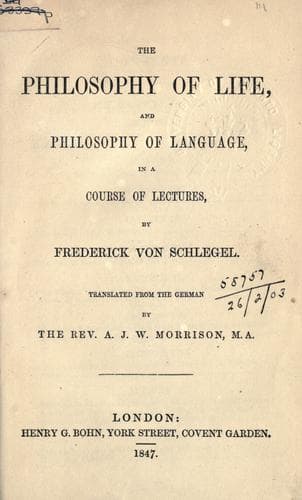
The philosophy of life, and philosophy of language, in a course of lecturesSchlegel, Friedrich von
Philosophy
The philosophy of life, and philosophy of language, in a course of lectures
Schlegel, Friedrich von
Language and languages -- Philosophy; Life; Philosophy
Egyptian architecture, with its predominantly mathematical character,
and the tree-like Gothic aspiring to heaven, with its slender shafts and
floral decorations, form the two extremes of this organic character
which belongs to architecture, and which constitutes it one and the same
art with sculpture. For the structures of the former environ and
surround the creations of the latter. And it is only consistent that
that which supplies the legitimate sphere and the natural medium for the
other properly exhibitive art of sculpture and its statues of the gods,
should even possess or acquire a similarity of character with it. As to
the Egyptian and Gothic architectures, the remark readily suggests
itself that the symbolical character displays itself predominantly in
them: purity of form, however, is the prevalent feature of the _antique_
(or Grecian), but even here in its proportions the symbolical principle
may be traced, although it is more recondite, not to say concealed.
Even poetry is no fourth art alongside of the other three. It does not
stand on the same line with and form, as it were, the complement of
their number. It is rather the universal symbolical art which comprises
and combines in different mediums all those other exhibitive arts of the
beautiful. In its rhythm and other metrical aids it possesses all the
charms of a music in words; in its figurative diction it maintains an
endless succession of shifting pictures in the vivid coloring of
diversified illustration; while in its entire structure (which must be
neither purely historical, nor logical, or even rhetorical) it strives
to attain, by a beautiful organic development and disposition of its
parts, to an arrangement of the whole both architecturally great and
correct.
Poetry owes in every instance its first creative beginning to some great
and singular ray of light from symbolical tradition, which, at the same
time, illuminates the noble and memorable past, and points forward to
the dark and mystical future. For it would be difficult to produce one
among the great epic poems of antiquity that does not contain this
poetico-prophetic element, and does not touch upon the profound
mysteries of both worlds. The next and middle step is occupied by the
poetry of sentiment and feeling--that music of the soul or poesy of song
in which the calm deep longings and the wild tearing passions of the
moment, once plunged and glorified in that immortal element, become
eternal. But the height of perfection in the organic development of
poetry is marked by the drama. This third and highest form of poetical
art has for its subject-matter the whole struggle of human life, which
in its vivid representations it aims to realize, and, as it were, to
bring bodily before our eyes.
Public-domain text, read in full here on John Shaqi.
Reviews
Reviews
No reviews yet
Be the first to share your thoughts on this work.
Elsewhere in the archive
Join the Discussion
Join the discussion
Sign in to leave a comment or review.
Sign InorCreate an account