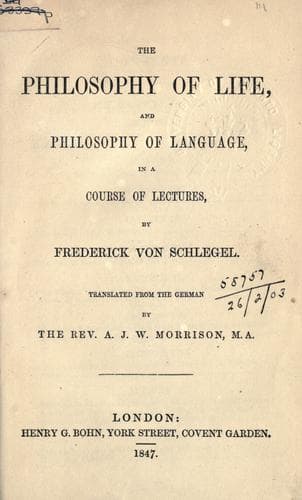
The philosophy of life, and philosophy of language, in a course of lecturesSchlegel, Friedrich von
Philosophy
The philosophy of life, and philosophy of language, in a course of lectures
Schlegel, Friedrich von
Language and languages -- Philosophy; Life; Philosophy
Of the fine arts, therefore, which, employing a material medium for
their representations, possess an ideal and symbolical significance,
music is the art of the soul, and sculpture is that of corporeal form,
and of the manifestation of the true idea of organic beauty. But among
the three sister arts, painting is the true spiritual one. As the light,
with its ceaseless variety of tints and hues, is the most spiritual
element of nature, and as the eye is the most spiritual of man’s senses,
so painting, as concerned about these, is the most spiritual of the
arts, and the one with which the symbolical spirit readily associates
itself. Painting directs itself wholly to the eye, whereas sculpture
appeals indeed to the eye, but only as the necessary medium for
satisfying the corporeal sense and feeling.
But painting, in its manifestations, does not confine itself to abstract
beauty (if we may so say) or the perfect structure and symmetry of form.
It embraces all the eye can reach in the visible phenomena of the world,
with all its wonderful play of light and shade and magical splendor of
coloring, where not only the whole, but the several parts--in a word,
all that in many and various ways is charming to the senses, attractive
to the eye with ever new wonders, and all that to the mind or spirit is
full of deep spiritual and symbolical significance. And for this reason
the wonderful art of painting is even the most appropriate, shall I say
to exhibit, or rather to suggest, the high mysteries of divine love in
religion and revelation. No wonder, then, if, in modern Christendom,
music and painting, the art or symbolism of soul and spirit, have been
chiefly cultivated, and attained their highest development and
perfection, whereas the art of the perfect development of organic form
and corporeal and sensual beauty, reached its height of excellence in
the sculpture of classical antiquity, which in the same way and degree
will never again be paralleled, or at least will never be surpassed.
It appears sufficient if we assume that there are only three symbolical
arts for the higher manifestation of the beautiful. For architecture,
although in various ways bound and modified by the conditions of some
ulterior design, is, nevertheless, in its principal features closely
related to sculpture, and stands on the same line with it. For beauty of
structure, correctness of proportion, and grace of symmetry, which form
the fundamental laws of the plastic art, constitute also the ideal of
architecture. Accordingly, among the Greeks and Romans, where the latter
attained to its highest and richest cultivation, its principles,
relations, and forms approximate to those of organic figure, to which
they are not indeed outwardly in their structure, but in a certain
degree and according to their internal constitution, similar and
correspondent, or at least related.
Public-domain text, read in full here on John Shaqi.
Reviews
Reviews
No reviews yet
Be the first to share your thoughts on this work.
Elsewhere in the archive
Join the Discussion
Join the discussion
Sign in to leave a comment or review.
Sign InorCreate an account